
Keonne Rodriguez
Software developer · Husband · Son · Miami Beach and Harmony, Pennsylvania

Written and published by 250pardons.com from public records. Not written, reviewed, or approved by Keonne Rodriguez, his family, or any attorney who has represented him. His legal positions are stated in his own filings, not here.
Five events, in the order they happened
- August 23, 2023The prosecutors asked the federal agency that regulates money transmission whether Samourai Wallet was a money transmitting business. FinCEN personnel said no — the software never held anyone's funds.
- February 14, 2024The grand jury indicted him for conspiring to operate an unlicensed money transmitting business.
- April 1, 2025The defense learned of the August 2023 conversation. Fourteen months after the indictment, and only because it asked.
- April 7, 2025The Justice Department published a memorandum telling prosecutors to stop targeting mixing services for what their users did. This prosecution continued.
- November 6, 2025He was sentenced to sixty months — the maximum the statute allows. He is serving it now.
This page is open and will change
Court records arrive slowly, and several documents that bear on this case are not yet in hand — among them the plea agreement, the transcript of the plea hearing, and the sentencing transcript. Rather than wait, we publish what is sourced, name what is missing, and update as documents come in.
Every factual claim below is tied to a court filing, a government document, or a statement Keonne Rodriguez made on the record and in public. The filings we rely on are published at the foot of this page so anyone can check them. Where a claim rests only on his own account, this page says so in the same sentence.
- August 18, 2026 — Page opened. Government's account, sentencing record, disclosure sequence, and three court filings published.
What the government says
The Justice Department's account, stated without softening
From 2015, Rodriguez and his co-founder built and ran Samourai Wallet, a bitcoin application whose two paid features — Whirlpool and Ricochet — the government says existed to hide where money came from. More than 80,000 bitcoin, over $2 billion at the exchange rates of the time, moved through them, and the business earned more than $6 million in fees. It never registered with FinCEN, and the government says it built no anti-money-laundering or know-your-customer program on purpose and advertised that it had none.
The Department says the money it traced through the service included proceeds of drug trafficking and darknet markets including Silk Road and Hydra, cyber-intrusions and frauds against decentralized finance protocols, transactions involving sanctioned jurisdictions, and murder-for-hire schemes. Its list goes further than what is printed here. This page does not restate the final category, and readers who want the government's account in full should read the announcement itself, linked below.
It also says the founders knew and encouraged it. Asked in a WhatsApp message to explain mixing, Rodriguez called it money laundering for bitcoin.
Company marketing materials named dark and grey market participants among the intended customers. In June 2022 the company account he operated welcomed Russian oligarchs as new users. In July 2020, as proceeds of a widely publicized social media hack were moving, he publicly urged the hackers to send those funds into Whirlpool, and expressed disappointment when they used a competitor instead.
He pled guilty. This page does not dispute any of it, and does not ask anyone to overlook it. What follows is not a claim that he is innocent. It is a set of dated facts about how the government built and resolved the case.
U.S. Department of Justice, Southern District of New York, sentencing announcement, November 20, 2025 —
read it on justice.gov
Plea announcement, August 6, 2025 —
justice.gov
Sealed superseding indictment, filed February 14, 2024 —
the charging document itself
What the announcements leave out
Each entry is a date and an event, sourced to a filing or a government document. Nothing here contradicts the government's account of what the software did.
Treasury's own guidance draws the line at custody. FinCEN guidance FIN-2019-G001 distinguishes an anonymizing software provider from an anonymizing services provider, and treats a provider that never takes control of the funds as outside the money transmitter definition. Samourai users' private keys stayed on their own phones. That is not the defense's characterization — it is stated in the government's own indictment. FIN-2019-G001; superseding indictment, paragraphs 9, 13 and 15.
The regulator told these prosecutors the conduct was not the offense. On a call with the prosecution team, FinCEN personnel said Samourai would not be considered a money transmitting business, because it was non-custodial. The government's position is that these were individual, informal and caveated views rather than FinCEN's institutional position. Defendants' letter motion, ECF 86; government response, ECF 88; defendants' reply, ECF 89; renewed motion, ECF 98 (May 29, 2025).
The grand jury indicted on unlicensed money transmission six months later. What the grand jury was told about the August 2023 call is not public. Superseding indictment. This page states only that the record is not public.
A man with no criminal record and a decade of open operation was arrested at home in an early-morning raid. He had lawyers. He spoke at conferences under his own name. The business ran a public website and distributed through the Google Play Store — a fact recorded in the indictment itself, because it lists the store fees the business paid. He says no one ever contacted him or his counsel to ask a question before that morning. Google Play Store fees: indictment, paragraph 11. The account of the raid and of the absence of prior contact is his own, given in recorded interviews.
The FinCEN conversation was disclosed fourteen months after the indictment, and only in response to a specific request for any communication with Treasury about whether a license was required. ECF 98 at 1–2.
The Justice Department published a policy naming this kind of business. Acting under the President's Executive Order 14178 of January 23, 2025, the Deputy Attorney General issued a memorandum titled Ending Regulation By Prosecution. It states that the Department will no longer target virtual currency exchanges, mixing and tumbling services,
and offline wallets for the acts of their end users or for unwitting regulatory violations, and that it will pursue criminal enterprises themselves rather than the platforms those enterprises use. Samourai was a mixing service. The prosecutors paused to consider dismissal, then went forward.
Memorandum of the Deputy Attorney General, April 7, 2025 — read it on justice.gov. Quoted and relied on in ECF 97 at 2.
There is a second FinCEN conversation that has never been produced. The government's disclosures about the August 2023 call refer to an earlier discussion in May 2023. The government declined to produce anything about it, saying it did not concern Samourai. It also redacted parts of the August 2023 material as privileged or non-responsive. The defense asked the court to review the documents privately and order release of what was not privileged, and noted that the government had given no explanation at all for the year-long delay. ECF 98 at 2.
The case changed judges. Filings through May 29, 2025 are captioned 24 Cr. 82 (RMB), before Judge Richard M. Berman. The July 22, 2025 transcript is captioned 24 Cr. 82 (DLC), before Judge Denise L. Cote, who said on the record that the case had recently been reassigned to her and that it was her first meeting with counsel. ECF 97 and ECF 98 (May 29, 2025); transcript of July 22, 2025, ECF 145, at 2.
The court imposed the statutory maximum. Counsel had asked for a year and a day. The court gave sixty months, three years of supervised release, and a $250,000 fine, and said deterrence required it. He surrendered six days before Christmas. DOJ announcement of November 20, 2025. The sentencing transcript is not yet obtained.
The software did not stop. He says that within weeks of the arrests, others forked the open-source code and reintroduced the mixing feature, running it through Tor with no public website and no social media presence. The prosecution removed the developers who operated openly and left running the version nobody can find. His account, given in recorded interviews.
Why he pled guilty
Eight days
The question anyone should ask is why a man who says he broke no law stood up and admitted a crime. The docket answers it.
On July 22, 2025, Keonne Rodriguez pled not guilty. At that same conference, three things were said on the record:
- The prosecutor told the court the government expected to file another superseding indictment within forty-five days, adding further unlawful activities to the money laundering count — the count carrying twenty years.
- The judge said the November 3 trial date was firm and would not move.
- The judge said she had reviewed the pending motions, including the motion to dismiss and the motion about the FinCEN call, and was going to deny them, some possibly by written opinion and some by oral ruling later.
On July 30, 2025, eight days later, he pled guilty to the five-year count, and the twenty-year count was dismissed.
He was facing a growing charge, a fixed trial date, and motions that had just been signalled to fail. Whatever else that is, it is not the position of a man weighing his odds freely.
Transcript of proceedings, July 22, 2025, No. 24 Cr. 82 (DLC), ECF 145, at 4–5 and 9–10. Guilty plea entered July 30, 2025 (DOJ announcement, August 6, 2025).
Who else was watching this case
This is not a claim made only by the man in prison and the people who love him.
On May 29, 2025, defense counsel told the court that five organizations had asked to file friend-of-the-court briefs, to help the judge understand the technology and what a ruling would mean beyond this defendant: the Blockchain Association and the DeFi Education Fund jointly; Coin Center and the Bitcoin Policy Institute jointly; and the Digital Chamber, which represents more than 200 members and told the court its members had relied for over a decade on FinCEN's guidance to decide whether they had to register.
Two months earlier, on March 26, 2025, a coalition of more than thirty organizations — including the Antonin Scalia Law School at George Mason University — wrote to the Senate Banking Committee, the Senate Judiciary Committee, the House Financial Services Committee, and the House Judiciary Committee raising concerns about this prosecution.
The government did not oppose the briefs. The filing notes that the Justice Department's own manual says its normal practice is to freely consent to amicus participation, and that refusing requires approval from the Solicitor General's office.
Letter of May 29, 2025, ECF 97, at 1–6. The court's ruling on that request is not yet obtained.
A second question, not yet answerable
What follows does not affect the argument this page makes. That argument is set out further down, and it rests only on the Justice Department's own published position and the length of the sentence.
United States v. Falcone, 311 U.S. 205 (1940)
Falcone sold sugar. He knew his buyers were bootleggers making illegal liquor with it. He was convicted of conspiring with them, and the Supreme Court reversed.
The Court held that knowing your product will be used in a crime does not, by itself, make you a member of the criminal conspiracy. A seller has to join the venture, not merely supply it while aware of what the buyer intends.
That case was argued in the motion to dismiss filed in this prosecution. The government charged conspiracy. Rodriguez wrote software and made it public. The question Falcone puts is whether the government's evidence — that he knew criminals used what he built, and said so — establishes that he joined their conspiracy, or only that he knew.
The motion was denied.
What he stood up and admitted
How the Department describes the count
Its announcements describe a conspiracy to operate a money transmitting business in which the defendants knowingly transmitted criminal proceeds — proceeds it traces to drug trafficking, darknet markets, sanctioned jurisdictions, murder-for-hire schemes, and further offenses set out in the Department's own release.
DOJ releases, August 6 and November 20, 2025.
How he describes his own allocution
He says he told his lawyer he would not stand in front of a judge and say he had done something he had not done, that the wording took considerable back and forth in writing, that the government did not object to it and the judge accepted it, and that what he admitted was this:
He created the software, and he knew it was possible for criminals to use it.
His account, recorded interview, December 2025.
These are not the same statement, and one document settles which is right: the transcript of the plea hearing. It is not yet obtained. Until it is published here, this page takes no position on which description is accurate.
In his own words, before he surrendered
Recorded in December 2025, weeks before he reported to Morgantown. The passage worth the time begins around fourteen minutes, where he describes negotiating the wording of his own allocution — he did not want to stand in front of a judge and say he had done something he had not. What he was left admitting was that he wrote the software and knew criminals could use it. The government did not object to that wording, and the court accepted it. Published by White Collar Advice, a prison consulting firm that works with him; linked here as a record of his own statements, not as an endorsement.
What he says he should have done differently
His sentencing submission does not claim he was faultless. In it he wrote that he could have paused operations to reassess his licensing obligations, could have gone to the regulators to ask what his responsibilities were in a changing landscape, and could have built a bigger compliance team.
None of that is a defense and he does not offer it as one. It is on this page because a person who concedes what he got wrong is easier to believe about what he says he did not, and because a page that prints only the favorable half of a man's own words is not worth reading.
Sentencing submission, quoted aloud in a recorded interview of December 2025. The submission itself is not yet obtained.
Before Samourai
He grew up in Miami Beach. His father left Cuba after the revolution, his grandparents having seen what was coming and got the family out; his mother was English and met his father on the beach. He was a bored student who stopped being bored the day he got a computer, and by middle school he was building websites — his church's first, then friends' and family's, then businesses' and artists'. At sixteen he told his father he could build a career without finishing school. His father agreed. He has worked with computers ever since.
In 2012 he was living in England and heard about bitcoin from friends. He went to a conference in London, met the founder of what became blockchain.com, and joined as its eighth employee. He met the man who would become his business partner, and later his co-defendant, in that same office.
His own account, given in recorded interviews of December 2025 and drawn from his sentencing submission.
December 15, 2025
The case reached the President
At a White House press briefing, a reporter described the case — a man going to federal prison for writing cryptocurrency privacy software, in a prosecution begun under the previous administration and carried to conviction by this one — and asked whether the President was familiar with it.
He said he had heard about it and would look at it. Then he turned to the Attorney General in the room and told her to take a look.
The exchange in full. It runs about thirty seconds.
This page will not make that more than it is. A statement that a case will be looked at is not a decision and not a commitment, and it is no part of the argument made here. It is reported because it is a fact about where the matter stands, and a reader is entitled to know it whichever way it cuts.
One correction to the coverage. Much of the reporting that week described him as sentenced for money laundering. He was not. That count was dismissed as part of the plea and there is no such conviction in this case. The single count of conviction is conspiracy to operate an unlicensed money transmitting business.
His mother's appeal
Keonne's mother has been asking publicly for her son's release. On July 5, 2026 she addressed the President directly, and linked the petition her family started.
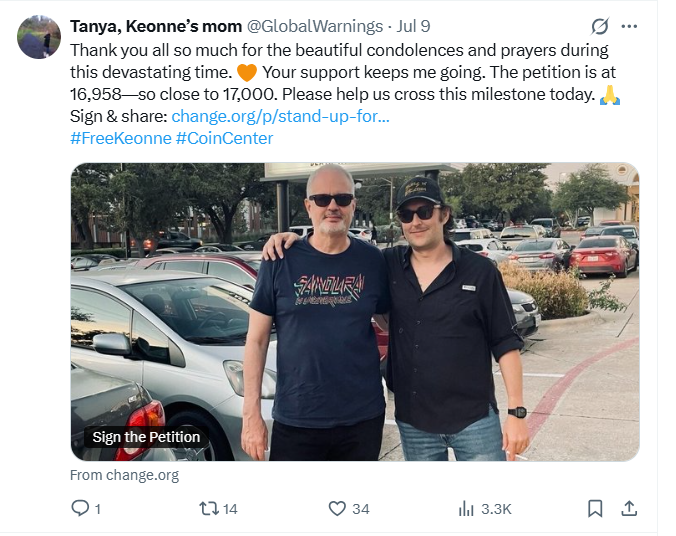
Posted July 5, 2026.
Keonne and his family maintain that what he did was not a crime. That position is theirs and this page does not speak for them. What this page does is set the record out in order — the government's account first, then the dates the announcements leave out — and let a reader judge whether a system working as intended produces this.
Hosted on change.org. Started by his family, not by this site.
Questions people ask about this case
Why is Keonne Rodriguez in federal prison?
He pled guilty to one count of conspiracy to operate an unlicensed money transmitting business, and was sentenced on November 6, 2025 to 60 months — the maximum the statute allows. He co-founded Samourai Wallet, a bitcoin privacy application, in 2015.
Was he convicted of money laundering?
No. The indictment charged conspiracy to commit money laundering, carrying a 20-year maximum. That count was dismissed as part of the plea agreement. There is no money laundering conviction in this case.
Why did he plead guilty if he says he broke no law?
He pled not guilty on July 22, 2025. At that hearing the government said it expected to file another superseding indictment expanding the 20-year money laundering count, the judge said the trial date would not move, and the judge said she would deny the pending motions. He pled guilty eight days later, and the 20-year count was dismissed.
Did Samourai Wallet hold customers' bitcoin?
No, and the government's own indictment says so. Users' private keys were stored on their own phones and were not shared with the company. Under Treasury guidance, custody is the line that separates a money transmitter from a software provider.
What did FinCEN tell prosecutors before the indictment?
On August 23, 2023, FinCEN personnel told the prosecution team that Samourai would not be considered a money transmitting business because it was non-custodial. The indictment followed six months later. The defense was not told about the conversation until April 1, 2025.
Has the Justice Department changed its position on cases like this?
Yes. On April 7, 2025, acting under Executive Order 14178, the Deputy Attorney General issued a memorandum stating the Department would no longer target mixing and tumbling services for the acts of their end users. In August 2025 a senior official said the Department would no longer bring these charges against software developers. Rodriguez was charged in February 2024, before both.
Have others been prosecuted the same way?
Others running cryptocurrency businesses accused of failing to register or maintain anti-money-laundering programs have received civil penalties or probation. The four BitMEX co-founders, prosecuted in the same district, each received probation and no prison. Rodriguez received the statutory maximum.
What is being asked for?
Executive clemency. Keonne Rodriguez is seeking it, and the form it takes is for the President and the Office of the Pardon Attorney to decide. This page does not choose it. It asks that someone outside the office that brought the case read the file.
Where is Keonne Rodriguez now?
He surrendered on December 19, 2025 and is serving his sentence at the Federal Prison Camp in Morgantown, West Virginia.
What happened to him
Seven things, each one sourced above. Where the government has an answer, it is printed with the item.
What the same accusation drew for other people
Sources: FinCEN, enforcement action against Eric Powers · FinCEN, $100 million action against BitMEX · U.S. Attorney, S.D.N.Y., sentencing of Arthur Hayes and guilty plea of Samuel Reed.
The difference a lawyer will point out, so this page points it out first
The BitMEX and Binance cases were charged under the Bank Secrecy Act's anti-money-laundering provisions. Rodriguez was charged under a different statute — 18 U.S.C. § 1960, which criminalizes operating an unlicensed money transmitting business. They are not the same offense and the maximum penalties differ.
What the rows share is the accusation underneath: running a cryptocurrency business without the registration and controls federal law requires. And each of those platforms took custody of customer funds. Samourai did not, which is the fact FinCEN itself identified when the prosecutors asked.
Six men ran exchanges that held other people's money, which the government said moved criminal proceeds. Between all six of them: four months. Keonne Rodriguez, who never held anyone's coins, is serving sixty.
What clemency has already reached
Every grant below is published by the Justice Department in its record of clemency grants, 2025 to present. This page takes no position on whether any of them was correct. What the table shows is the range the power has already covered in this exact area of law.
| Recipient | Offense of conviction | Sentence served | Outcome |
|---|---|---|---|
| Arthur Hayes BitMEX, S.D.N.Y. |
Bank Secrecy Act — willful failure to maintain an AML program | Two years' probation, six months home detention | Pardoned March 2025 |
| Benjamin Delo BitMEX, S.D.N.Y. |
Same offense | Thirty months' probation | Pardoned March 2025 |
| Samuel Reed BitMEX, S.D.N.Y. |
Same offense | Eighteen months' probation | Pardoned March 2025 |
| Gregory Dwyer BitMEX, S.D.N.Y. |
Same offense | Twelve months' probation, $150,000 fine | Pardoned March 2025 |
| Changpeng Zhao Binance |
Bank Secrecy Act | Four months | Pardoned October 2025 |
| Keonne Rodriguez Samourai Wallet, S.D.N.Y. |
Conspiracy to operate an unlicensed money transmitting business | Sixty months — the statutory maximum | Serving |
Nothing on this page asks for an exception or a new standard. It asks for the ordinary exercise of an ordinary power, in an area where it has already been exercised five times.
Why this reaches past him
Take the bitcoin out of it. What is left is machinery, and none of it is specific to writing privacy software.
- Following the published rule is not a defense. Treasury said in 2013 and again in 2019 that you have to hold the money to be a money transmitter. He read it and built accordingly. The criminal statute has its own definition, and prosecutors are not bound by the regulator's.
- Asking first does not protect you. Here the prosecutors themselves asked the agency, got an answer that helped him, and charged regardless.
- Knowing your product can be misused can be charged as joining the misuse. The Supreme Court said in 1940 that knowledge alone is not a conspiracy. That argument was made here and the motion was denied.
- The charge can grow while you decide whether to fight it. At the hearing where he pled not guilty, the government said it expected to file another indictment expanding the twenty-year count.
- A policy change does not reach backwards. The Department's new position arrived while he was still a defendant, and it did not help him.
- Operating in the open is not protection. Ten years, a public website, conference appearances under his own name, lawyers, distribution through the Google Play Store — and the first contact was agents at the door.
- What you earned is gone before anything is proven. Forfeiture, a fine, and legal bills arrive whether or not there is ever a trial.
None of that requires a mixing service. It requires building a tool someone else can misuse — a messaging app, a payment processor, a hosting company, a hardware wallet, a marketplace. It requires reading a federal agency's published guidance and doing what it says.
This page is not saying he did nothing. He pled guilty, and the government says he knew what his software was being used for. The claim is narrower and harder: not one item on that list turns on how serious the conduct was, or on whether it was ever proven. Every one of them attaches the moment the government decides to charge you.
He is one software developer in Pennsylvania. The machinery that produced five years for him is federal, and it is everywhere.
The line this page will not cross
We do not claim the prosecutors broke the law. A court reviewed the disclosure motion and denied it. We print what the filings say and let the reader weigh it.
We do not claim we know why the case changed judges. We print the case captions and the dates and nothing more.
We do not state whether the conduct was or was not a crime. He pled guilty; he and his family say it was never a crime; the government says otherwise. That argument is theirs, not ours.
We claim one thing: the agency that writes the rule told these prosecutors it had not been broken, the Justice Department later published a policy against bringing the charge, and a man is serving the maximum sentence for it while others accused of the same failures served none.
What this page asks
The rule changed. He is still in prison under the old one.
In April 2025, the Justice Department published a memorandum telling its own prosecutors to stop going after mixing services for what their users did. It named that category of business directly. It was issued under an executive order the President had signed three months earlier. In August 2025, a senior Justice Department official said the Department would no longer bring these charges against software developers at all.
Keonne Rodriguez was charged in February 2024, before either announcement. He is serving five years — the most the law allows — for conduct the Justice Department has since decided it should not be prosecuting.
The government has an answer, and it belongs here. The April 2025 memorandum is not absolute. It still permits the charge where a person knew he was required to register and chose not to, and the government says that describes this case. That may be right. It is also true that these prosecutors stopped and considered dropping the case under that new policy before deciding to continue — so the Department itself was not sure.
He had never been in trouble before. His lawyers asked for a year and a day. The judge gave him the full five years. Four men prosecuted in the same courthouse for failing to run an anti-money-laundering program at an exchange that held customer funds received probation, and were pardoned.
Keonne Rodriguez is seeking executive clemency. He and his family maintain that what he did was not a crime. What form clemency takes is for the President and the Office of the Pardon Attorney to decide. What this page asks is that someone outside the office that brought this case read the file — because the facts in it should concern anyone, whatever they conclude about him.
To Keonne Rodriguez's family
This page is our attempt at the record, assembled from what is public. It is not the whole story and it is not finished.
We know which parts are missing. The plea agreement. The transcript of the plea hearing, which settles what he actually admitted. The sentencing transcript and what the court said when it imposed the maximum. His sentencing submission. And the part no filing contains — who he is, what these years have cost, what a household looks like when one person is gone for five.
If Keonne wants to publish a letter on this page, he is welcome to, through his family, in his own words and unedited. If anything here is wrong, tell us and we will correct it and log the change at the top.
What everyone else can do
This page exists because almost nobody hears about cases like this one. The announcement travels. The record does not.
- Read it and pass it on. Send it to one person who would find it hard to believe.
- If you know a reporter, tell them. Every document on this page is public and linked. It can be checked in an afternoon.
- If you are a lawyer, we want to hear from you — including if you think we have something wrong. Corrections make this stronger.
- If you build software, read the list above again and ask which parts of it could not reach you.
- If you have any of the documents named below, send them.
Keonne Rodriguez has been in federal custody since December 19, 2025.
Share this page
Reporters, lawyers, and anyone with documents
Follow 43 Americans on Facebook for the other forty-two cases.
The record
The filings this page relies on, published in full so anyone can check what is said above against what the documents actually say.
Documents we are still seeking
Other cases
Last updated August 18, 2026 · One of 43 documented federal cases
Who wrote this, and how
This page was written and published by 250pardons.com from publicly available records. Court filings, Justice Department and FinCEN announcements, a published memorandum of the Deputy Attorney General, and interviews Keonne Rodriguez gave publicly before he surrendered. Every source is named and, where it exists online, linked.
This case came to the campaign through contact between Ed Rosenberg, who documented the first forty-two cases, and Keonne's mother. Nothing on this page came from her or from anyone in the family. It was assembled from the public record by the people who built it. Keonne did not write it, has not seen it, and no lawyer wrote it, reviewed it, or endorsed it. Nothing here should be attributed to any attorney who has represented him at any stage.
Where this page says he says something, the passage comes from a recorded interview he gave publicly or from a document filed in his case. Everything else — the arguments, the characterizations, the conclusions — belongs to the people who built this page and to nobody else.
This page is not a legal filing and does not state his legal position. Wherever anything here differs from what he or his representatives have argued or will argue, their words govern and this page does not.
Nothing here is legal advice, and nothing here should be read as a prediction of any outcome.
A note on quotation and proof. Passages presented as quotations are exact text from a named transcript, filing, government document or published interview, with the source identified. Figures drawn from Justice Department announcements are the government's own. There was no trial in this case, so no jury has found any fact in it. Statements introduced with he says are his account and have not been tested by cross-examination. Document numbers refer to the docket in United States v. Rodriguez and Hill, No. 24 Cr. 82 (S.D.N.Y.). Several documents that bear on this case — among them the plea agreement, the plea hearing transcript and the sentencing transcript — are not yet obtained; where a conclusion depends on one of them, this page says so rather than drawing it.
If any passage on this page does not match the record, tell us and we will correct it, and the correction will be logged at the top of the page. That promise is the only thing that makes the rest of it worth reading.