
Elizabeth Hernandez
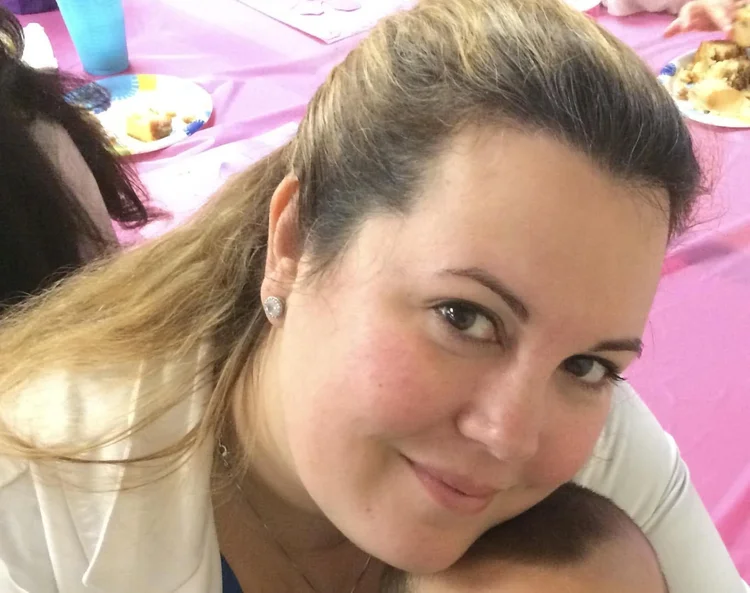
Nurse practitioner, Homestead, Florida. Mother of five. No prior record. In May 2021 the Justice Department put a plea agreement in front of her and gave her three days to sign it. The offer was three years. She refused, because signing meant saying something she says was not true. Eleven months later the Department charged her with a twenty-year offense, and she received every month of it.
The Department wrote its own number down before it charged her. The plea agreement it sent her counsel in May 2021 fixed the intended loss at $15,170,133 and carried a ten-year statutory maximum, and the offer on the table was three years. She would not sign it. At sentencing the Department presented $192 million and asked the court to apply a twenty-year statute. Her conduct did not change between those two documents. Only her answer did.
Then: forty minutes for the government, thirty for her. When her lawyer reached thirty minutes, the court cut her off in the middle of her closing argument. She asked for ten more. The court said no. After the government finished its rebuttal she objected again, explaining she had not had time to reach the false statement counts, the loss amount, or good faith.
Three appellate judges reviewed it. Two found the trial court had abused its discretion — and held it harmless. The third wrote that there had been no error at all.
She is serving twenty years.
What this page shows
- Who she was before any of this: a nurse practitioner who made the decision at her father's hospital bedside, and whose first patient was him.
- The plea agreement the Justice Department drafted, and what it charged her with after she declined to sign it — both documents, side by side.
- Her own doorbell camera, with timestamps, recording how the government came to her house twice. Both visits came after she refused the plea.
- Two separate findings of error at her trial, each reviewed separately, each found harmless separately.
- The government's own count table, in which the same three patients appear twice each — once for the $200 she billed, once for the $9,931 the laboratory billed.
- What the Justice Department gave everyone else in this scheme, including the man its indictment names as the person she is alleged to have conspired with.
- The government's case against her, in the government's terms, without omission.
- Her letter to the President, in full, in her words.
Before
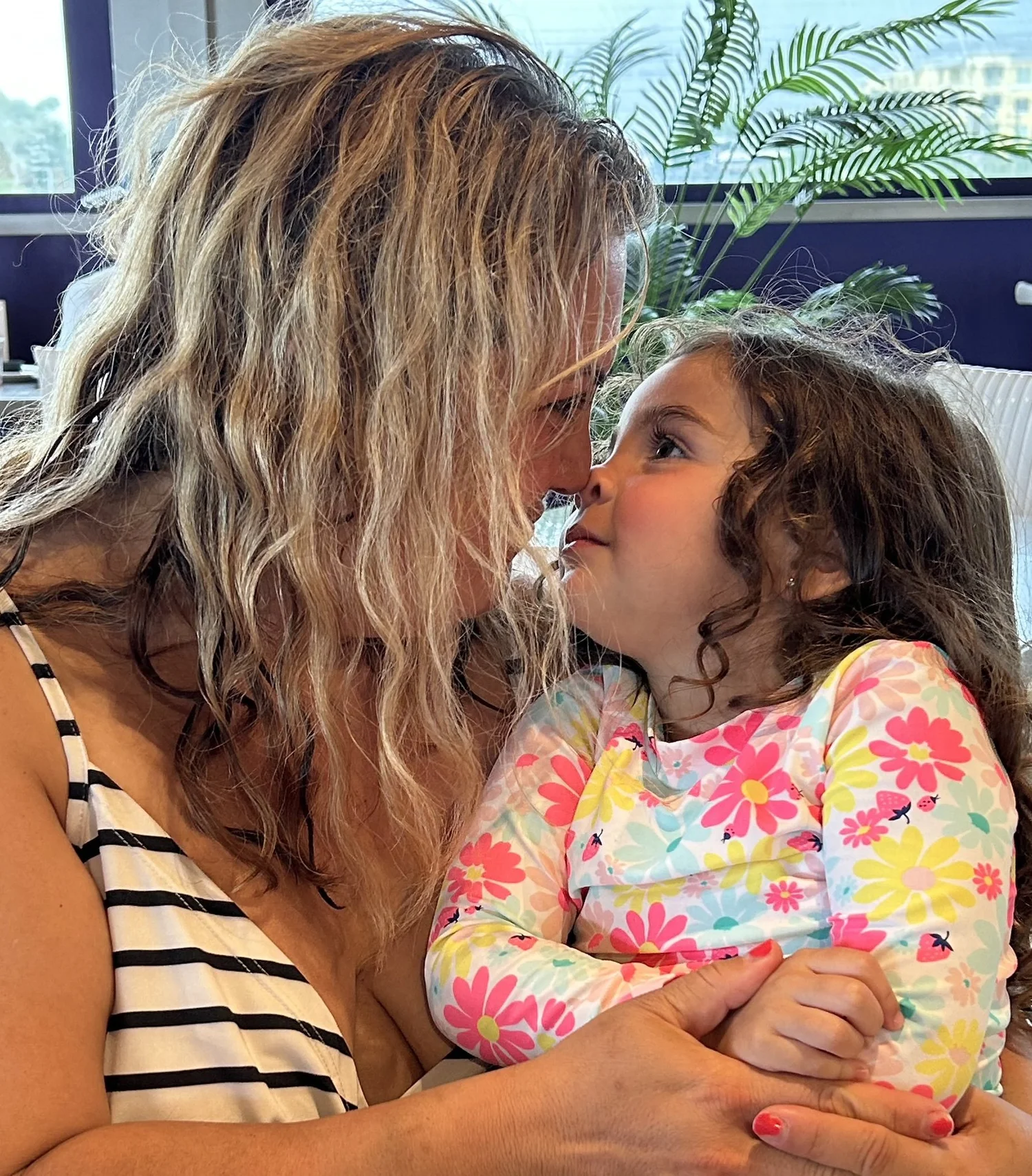
She wanted to work in medicine from about the age of ten. First a dentist. At sixteen, a pharmacist — she took a job at a pharmacy and changed her mind again. She spent a year in the pre-med program at the University of Miami, then went on taking two classes a semester because she was working full time in the reservations department of a cruise line and paying for school herself, on loans and financial aid, because her family could not.
She was twenty-one when her father was admitted to the hospital. She stayed at his bedside for ten days. She kept him clean, fed him, and sat with him. She watched the nurses look after him, and she made her decision standing in his hospital room.
My father was the first patient I cared for. I helped keep him clean, fed him, and comforted him while he was hospitalized. He died 10 days later.
Elizabeth Hernandez · written statement provided by her family, 2026She graduated in April 2010, top of her class, summa cum laude, in a white maternity dress with flowers on it, three months pregnant with her third child. Her mother says she took graduate courses during her undergraduate program, which required special approval from the dean. She went straight on to a master's degree and finished that at the top of her class too, in August 2011.
She started work in September 2011 at Kendall Regional Medical Center — the same hospital where her father had died. Three months in she was made charge nurse, responsible at one time for eight nurses, four medical technologists, and forty-eight patients. A few months after that, according to her mother, the hospital's chief executive arranged for her to work in the emergency room as a nurse practitioner.
I loved working in the emergency room. The fast paced environment kept me on my toes. I loved to educate patients about their conditions. I would take my time to explain and print out supporting information so that they understand their condition thoroughly. I always felt knowledge was power and if they knew everything they had to know about their condition, they would have a better handle on it in order to heal quickly.
It was so gratifying to my soul to help sick people heal. I loved my work. I woke up everyday looking forward to a new day at the hospital. The difference between other nurses and myself is that most people go to work because that is what they chose as a profession. Medicine was not a choice for me; it was a calling.
Patients and their caregivers always expressed their gratitude to me. Sometimes they would return days later with a box of doughnuts or pastries. I was always so happy to help them. The first time I was called by my title, I was so proud. I had worked for over 10 years to get to where I was and I glowed with pride.
Elizabeth Hernandez · written statement provided by her family, 2026She remembers the hardest shift she ever worked: a three-year-old girl brought into the emergency room in organ failure, dead within a few hours, and her family in the room.
She had been placed in that emergency department by a staffing agency, Barton and Associates, which hired her in 2015. In 2018 her emergency room hours were substantially reduced, and she went back to the agency and asked for more work. The agency told her to obtain licenses in other states so she could take remote telemedicine assignments, and then placed her with several telemedicine companies at once. Her contracts were for telemedicine services and chart review.
In 2017 a difficult pregnancy had put her on bedrest. In 2019, pregnant with her fifth child, she was placed on bedrest again from the day she found out. She worked from home, at volume, early in the morning until late at night, and hired nurses and medical assistants to help her keep up.
The charts she was signing in those months are the charts this case is about.
The offer she would not sign
On 25 May 2021 the Justice Department sent her newly retained counsel a completed plea agreement. The Department had by then been producing discovery to her lawyers since October 2020. It had done its arithmetic. The agreement is in the record section below and every figure in it is the Department's own.
It asked her to plead guilty to an Information — a charging document filed by the prosecutor, without a grand jury — containing a single count of conspiracy to commit health care fraud under 18 U.S.C. § 1349. The agreement states the statutory maximum plainly: ten years.
It asked her to stipulate that her participation "resulted in an intended loss of $15,170,133." It set restitution at approximately $7,917,823, joint and several with her co-conspirators. It fixed the adjusted offense level at 28 and bound the Department to recommend a sentence at the low end of the resulting range.
The covering email gave her until 5:00 p.m. that Friday — three days — and added that if she wished to provide assistance to the government, that window was rapidly closing.
The sentence on the table was three years. Her family has said so consistently since 2021, and the agreement is built to produce it: no plea agreement states a number, but this one caps the offense at ten years, binds the Department to recommend the low end of the range, and holds open a cooperation motion that can carry a sentence below the range entirely. Three years was the deal. Ten years was the worst it could ever have become. She is serving twenty.
She did not sign it. Her counsel wrote back that there were statements in the proffer that she could not sign without committing perjury, and asked for an extension to work through them.
What happened next is the entire case.
| Term | What the Department offered her — 25 May 2021 | What the Department did after she declined |
|---|---|---|
| Sentence on the table | 3 yearsThe offer, transmitted 25 May 2021 with a three-day deadline | 240 monthsTwenty years. The statutory maximum. Imposed after a six-day trial |
| Statutory maximum | 10 yearsOne count of conspiracy to commit health care fraud, by Information | 20 yearsIndictment adding wire fraud as an object of the same conspiracy, plus substantive counts |
| Intended loss | $15,170,133Stipulated in the Department's own draft agreement | $192,000,000Presented at sentencing. Twelve and a half times the figure it had written down |
| Restitution | $7,917,823, joint and several with co-conspirators | $1,600,000 imposed by the judgment — roughly one-fifth of what the Department asked her to stipulate to |
| Grand jury | Waived. An Information is filed by the prosecutor alone | Indictment returned 14 April 2022 |
| Time to decide | Three days | Six days of trial, then the maximum the statute allowed |
Sources: plea agreement and transmitting correspondence, U.S. Department of Justice, Criminal Division, Fraud Section, 18–25 May 2021 (paragraphs 1, 3, 13(b), 14, 15 and 21); indictment, No. 22-cr-20152 (S.D. Fla., filed 14 April 2022); judgment and Eleventh Circuit opinion, 31 July 2026. The 2021 loss worksheet the Department circulated with the agreement breaks its own $15.9 million billed figure into $12,191,388 in equipment, $821,950 in telemedicine consultations, and $2,869,066 in laboratory billing.
No new conduct is alleged after May 2021. Nothing she is accused of doing happened in the eleven months between the offer and the indictment. The Department's estimate of what she cost Medicare rose by $177 million, and the statute it charged her under doubled, in a period during which the only thing that changed was that she said no.
She was told three years was what her conduct was worth. When she declined to say it was true, the same conduct became a twenty-year count. Both numbers came from the same office, about the same woman, on the same facts.
Federal law has a name for this, and a case that permits it. In 1978 the Supreme Court considered a Kentucky prosecutor who offered Paul Hayes five years on a forged check for $88.30 and told him that if he did not plead guilty he would be reindicted as a habitual offender. Hayes said he was innocent and went to trial. He was sentenced to life. The Court upheld it, five to four, holding that a prosecutor who openly presents a defendant with the choice between pleading and facing heavier charges does not violate due process. Four justices disagreed.
The rule she was sentenced under
In this case, the prosecutor's actions denied respondent due process because their admitted purpose was to discourage and then to penalize with unique severity his exercise of constitutional rights.
Justice Lewis F. Powell, Jr., dissenting · Bordenkircher v. Hayes, 434 U.S. 357 (1978)
Powell also noted that five years for uttering a single $88.30 check “hardly could be characterized as a generous offer.”
Powell was in the minority. The majority is the law, which is why nothing that happened to Elizabeth Hernandez between May 2021 and April 2022 was unlawful, and why no court is going to disturb it. A prosecutor may raise the charge because a defendant refused to plead. That is settled. What is not settled is whether a country should hand a mother of five twenty years for exercising a right the Constitution gives her, and no court is permitted to ask that question.
They came twice
Her own doorbell camera recorded both visits, five months apart. The first came five months after she refused to sign.
4 November 2021, 7:15 in the morning — the search warrant
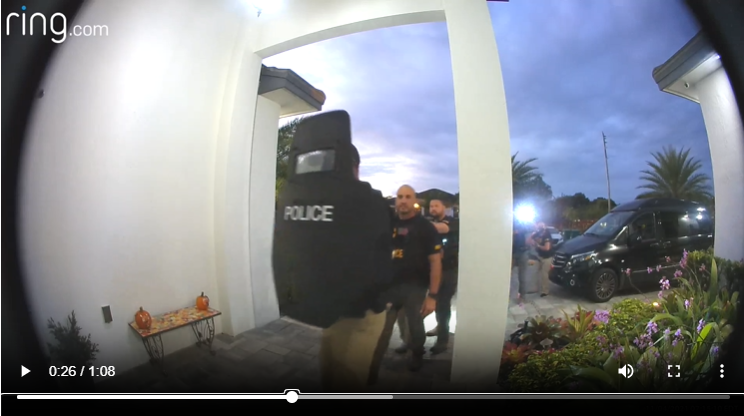
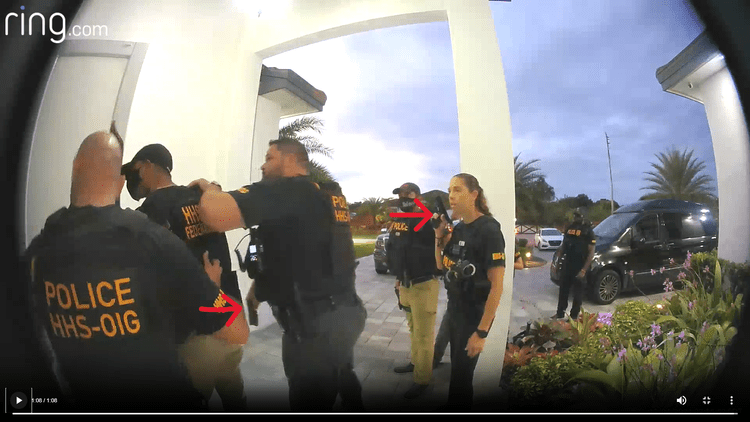
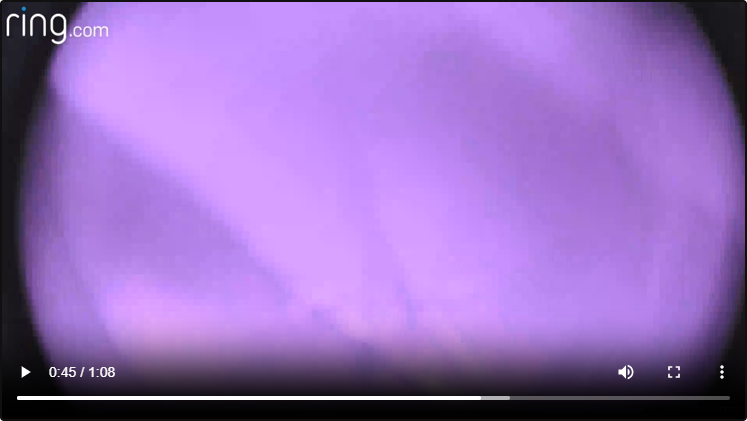
Agents from HHS-OIG and other federal offices arrived to execute a search warrant. Three of them have handguns drawn. One carries a ballistic shield.
At thirty-two seconds an agent notes that there is a Ring camera. Four seconds later they shout through the door that this is the police with a search warrant and to open it. At forty-five seconds — thirteen seconds after the camera was pointed out — an officer places a hand over the lens and holds it there. At fifty-eight seconds they call for Mr. Sanchez to come out. A female officer tells the officer who is shouting that there are two children inside. He then calls for the husband and the two children to come out.
Nobody resisted. No weapon was found on anyone in that house. Nothing happened that morning that would tell anyone this family was dangerous.
She was already represented that morning. She had retained counsel in May 2021 — the same month the Department sent the plea agreement, and six months before this warrant was executed. The Department knew who her lawyer was. It had been emailing him.
19 April 2022, 6:02 in the morning — the arrest
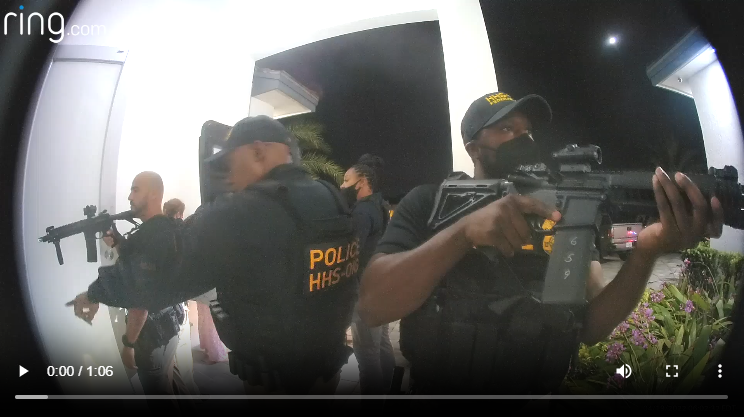
Five months later they returned to the same door, in the dark, with rifles. This was the morning they arrested her. She was taken out of her own house barefoot, in her pajamas. The indictment had been filed five days earlier.
They had already been inside this house. They knew the layout, they knew who lived there, and they knew there were children. They had executed a warrant here once and met no resistance of any kind. Nothing in the intervening five months changed that.
By this morning she had been represented by counsel for nearly a year. Her family reports that her lawyer was in communication with the government about her case and was to make arrangements for her to turn herself in.
A represented defendant in a paperwork case, who has already been searched once without incident, is ordinarily summoned or allowed to surrender at the courthouse. That is not a courtesy; it is routine, and it costs the government nothing. The Department decided against it here, twice.
Elizabeth Hernandez was charged with signing paperwork. No violence was alleged. No weapon was alleged. She had no criminal record of any kind. She was a nurse practitioner living at home with her husband and five children, the youngest of them four years old.
Her family's account is that her teenage son was put face down on the ground with a rifle pointed at him, and that her husband was held the same way. Those moments are not published here.
Three years before any of this, police had come to the same door. She had called them herself. Body camera video from that visit, obtained and broadcast by NBC6, shows her standing at her own house telling the responding officer that companies were using her provider number without her authorization. The government later told the jury she made that report to cover her tracks.
She called them to that house once. This is how they came back.
Why the time mattered
The reason the trial court gave for the split was that the side carrying the burden of proof should get more time. The Eleventh Circuit rejected that outright. The government carries the burden in every criminal case in America, which is precisely why it cannot be a reason to give the government more time than the accused.
The district court “abused its discretion by applying this unusual presumption of unequal treatment.” Verbatim · United States v. Hernandez, 11th Cir., 31 July 2026
Then the court held it made no difference:
“It is inconceivable that granting Hernandez ten extra minutes could have overridden the extensive trial evidence of her guilt.” Verbatim · United States v. Hernandez, 11th Cir., 31 July 2026
That is harmless error review. A reviewing court can find that a trial court got something wrong and still affirm, if it concludes the outcome would have been the same. It is a legitimate doctrine and it exists for good reasons. It is also the mechanism by which a finding of error produces no remedy.
Judge Luck concurred in the judgment only. In his view a defendant is entitled to an opportunity to argue and enough time to make her legally tenable arguments, and nothing more. One of the three judges who reviewed this record would not call the split an error in the first place.
And then the jury was told the opposite of the law
Good faith was one of the defenses she said she ran out of time to argue. Good faith is a complete defense to health care fraud: if she believed what she was doing was lawful, she is not guilty. The government must disprove it. She does not have to establish it.
When the trial court read the instructions aloud, it told the jury that a defendant is required to prove good faith.
That is the opposite of the law. The panel held the error was not reversible because the written instructions the jury took back with them were correct.
According to Hernandez, the jury was also given a deliberate ignorance instruction — the charge, sometimes called willful blindness, that permits a jury to find knowledge where a defendant deliberately avoided learning the truth. The indictment invokes the same concept: it alleges she falsely certified that she would not submit claims “with deliberate ignorance or reckless disregard of their truth or falsity.”
Set the findings side by side. She was denied the time to argue good faith, and the jury was then told aloud that the burden on good faith was hers. Each was reviewed separately. Each was found harmless separately.
What no court has examined, and no court is permitted to examine, is what happened inside that jury room after those instructions were read. Federal Rule of Evidence 606(b) bars testimony from any juror about the deliberations, with narrow exceptions that do not reach a misstatement of the burden of proof. The record contains no deadlock note and no supplemental charge. The verdict was reached after a six-day trial in which the correct statement of the law existed only on paper the jury carried back with it, against a spoken instruction from the bench that reversed it. Whether the jury followed the paper or the judge is a question the rules of evidence make permanently unanswerable. The President is under no such restriction.
Six counts, three patients, two bills each
The indictment charges six substantive counts of health care fraud. Each is a single Medicare claim for a single patient. There are only three patients, because each appears twice — once for the claim she submitted, and once for the claim the laboratory submitted. The government listed the billing entity and the amount for every one of them.
| Count | Patient | Date | Billing entity | Amount billed | Service |
|---|---|---|---|---|---|
| 2 | J.W. | 7 Aug 2020 | Elizabeth Hernandez | $200.00 | New patient outpatient visit, 45–59 min |
| 5 | J.W. | 9 Oct 2020 | Amerihealth | $9,931.69 | Molecular pathology, level 9 |
| 3 | P.K. | 15 Sep 2020 | Elizabeth Hernandez | $200.00 | New patient outpatient visit, 45–59 min |
| 4 | P.K. | 16 Sep 2020 | Amerihealth | $9,931.69 | Molecular pathology, level 9 |
| 6 | M.N. | 15 Oct 2020 | Elizabeth Hernandez | $200.00 | New patient outpatient visit, 45–59 min |
| 7 | M.N. | 27 Oct 2020 | Amerihealth | $13,600.62 | Molecular pathology, level 9 |
Source: indictment, United States v. Hernandez, No. 22-cr-20152 (S.D. Fla., filed 14 April 2022), pages 13–14. The table above reorders the counts by patient. The amounts, dates, billing entities and service descriptions are the government's own.
Her three claims come to $600. The laboratory's three claims, for the same three patients, come to $33,464. Amerihealth Laboratory is one of the Panda laboratories. She did not own it, did not set its prices, and was not paid out of what it collected.
Three different sets of claims
The indictment separates the money into three streams, and it uses different language for each.
Equipment. Roughly $14 million in claims for durable medical equipment, which the indictment alleges “Hernandez and her co-conspirators submitted and caused the submission” of.
Genetic testing. Roughly $119 million, in the same formulation — Hernandez and her co-conspirators. These are the claims the laboratories submitted.
Telemedicine consultations. Roughly $1.3 million, and here the language changes: Hernandez “submitted and caused the submission.” No co-conspirators. This is the only figure in the indictment attributed to her alone, and these are the $200 claims in the table above.
Approximately $134 million alleged. Under one percent of it billed under her own name.
The number that built the sentence
Her twenty years was calculated on $192 million in intended loss. The appellate opinion records that the amount actually billed to Medicare was $111 million. Those claims were submitted by the companies that engaged her. She received $1.66 million in total.
The $111 million is not money she billed. It is the total of Medicare claims attributed to her National Provider Identifier as the referring provider. She did not own or operate the companies that submitted those claims, did not control their billing, and did not receive that money. A sentence that describes her as having billed Medicare $111 million describes something that did not happen.
The provision doing the work is the loss table at U.S.S.G. § 2B1.1, and the commentary reading “loss” to mean the greater of actual or intended loss. Every additional dollar of intended loss climbs the table, and the table is what converts a paperwork case into decades. She argued the sentence should rest on actual loss rather than on an intended loss that no one ever received. The panel held that circuit precedent forecloses the argument in this circuit, and noted she has preserved it for the full court or the Supreme Court.
On what that table produces
the utter travesty of justice that sometimes results from the guidelines' fetish with abstract arithmetic, as well as the harm that guideline calculations can visit on human beings if not cabined by common sense
Judge Jed S. Rakoff, United States District Court, S.D.N.Y. · United States v. Adelson, 441 F. Supp. 2d 506, 512 (S.D.N.Y. 2006)
The loss table produced a life sentence for a company president convicted at trial in an accounting fraud. The court refused to impose it and sentenced him to forty-two months.
Twenty years is also the statutory maximum on Count 1. No longer sentence was available.
The same judgment ordered her to pay $1.6 million in restitution. Her sentence was calculated on $192 million. The court that imposed both numbers set the second at roughly eight-tenths of one percent of the first. And the Department's own plea agreement, drafted before it charged her, had put the restitution figure at $7.9 million — nearly five times what the court eventually found she owed.
What she was paid
She received $1.66 million across roughly three years of telemedicine work. That is not in dispute, and the government's release describes what she spent it on. That figure is the total of everything she was paid by every telemedicine company she contracted with. Most of those companies were never even discussed at her trial. What is disputed is what the money was for and what she could see from where she sat.
Her account, unchanged since her first interview with investigators, is this. She was a contracted provider — one of many — paid a flat fee for each chart she reviewed, at fair market value for the professional service performed. She was paid for the review, not for the signature. She did not set the price of a claim, did not know what the companies billed for any given test or piece of equipment, and did not know what Medicare paid them.
The Department's own account of her proffer contains the same structure. Its May 2021 correspondence records her statement that she was paid regardless of whether or not she signed a given order.
That payment structure matters more than it first appears. Her fee was the same whether the laboratory then billed Medicare five hundred dollars for that test or five thousand. The $192 million was built entirely out of what the laboratories charged — a number she did not set, could not change, and did not share in.
She received less than one percent of it.
What the Justice Department gave everyone else
Every sentence below comes from the Justice Department's own press releases or court records, each linked. The first name is the man her indictment identifies as a person she is alleged to have conspired with.
Same scheme · Same district
Michael Stein. Named in her indictment. Ran the companies that recruited and onboarded the telehealth practitioners who signed the orders, and admitted taking $50,000 a month to do it. Ordered to pay $63.3 million in restitution.
Elizabeth Hernandez. One of the practitioners he recruited. Contracted to review charts for a flat fee. Owned nothing, set no prices. Ordered to pay $1.6 million in restitution.
Stein pleaded guilty on the eve of trial; four further health care fraud counts were dismissed under his plea. Hernandez went to trial. Forty times the restitution, one quarter of the sentence.
| Who | Role | Scale | Resolution | Sentence |
|---|---|---|---|---|
| Michael Stein1523 Holdings LLC · S.D. Fla., same scheme | Named in her indictment. Arranged for telemedicine providers to refer Medicare beneficiaries to the Panda laboratories for genetic testing; admitted receiving $50,000 a month. | $63.3 million restitution | Guilty plea, eve of trial; four counts dismissed | 60 months |
| Leonel PalatnikPanda Conservation Group · S.D. Fla., same scheme | Co-owner of the laboratories that billed Medicare and collected. Admitted paying the kickbacks to Stein through a sham contract for purported IT and consultation services. | $73 million scheme | Guilty plea | 82 months |
| Jean WilsonNurse practitioner · DOJ, 30 June 2026 | Owned two telemedicine companies. Paid kickbacks for signed orders, signed many herself, resold them at about $90 a beneficiary, concealed proceeds through shell accounts and nominee owners. | $136M claimed · Medicare paid $66M | Guilty plea | 120 months |
| Reinaldo WilsonCo-conspirator · DOJ | Telemedicine company owner in the same conspiracy. | $56 million | Guilty plea | 84 months |
| Scharmaine Lawson BakerNurse practitioner · DOJ, 17 June 2026 | Telehealth contractor. Per DOJ: took kickbacks, signed orders after calls typically under thirty seconds, ordered ovarian and cervical cancer tests for male patients, never reviewed a result. | $12.1M claimed · $1.5M restitution | Convicted at trial | 87 months |
| Elizabeth HernandezNurse practitioner · contracted chart review | Contracted provider paid a flat fee per chart. Owned no company, set no prices. $1.3 million of the alleged claims billed under her own name. | $192M intended · $111M billed by others · $1.6M restitution | Convicted at trial | 240 months |
Stein and Palatnik were prosecuted in the Southern District of Florida in the same scheme; the government's own filing in her case states that hers relates to their earlier case, No. 21-cr-20321. Wilson and Lawson Baker were separate prosecutions in other districts, on different charges and different figures, and this page does not pretend otherwise. This page takes no position on whether any of these sentences was correct, and does not suggest any of them was too short. What the table shows is where in the chain the longest sentence landed. Someone had to call the patients. Someone had to recruit the signers. Someone had to sign. Someone had to bill and collect. Of those roles, the one that drew twenty years was the signature.
Lawson Baker matters for a second reason. She was convicted by a jury, as Hernandez was, and her restitution order was roughly the same size. Whatever explains the gap between 87 months and 240 months, it is not that one of them refused to plead.
How clemency has been used for this offense
The pardon power has reached this offense before. Every figure below is from the Justice Department's own published record of clemency grants, and each name links to the signed warrant.
Clemency granted for health care fraud, January 2025 – July 2026 — U.S. Department of Justice, Office of the Pardon Attorney
| Recipient | District | Offenses | Sentence | Restitution | Outcome |
|---|---|---|---|---|---|
| Lawrence S. Duran | S.D. Fla. | Conspiracy to commit health care fraud; health care fraud (11 counts); conspiracy to defraud the United States and to receive and pay health care kickbacks; conspiracy to commit money laundering; money laundering (18 counts); structuring (6 counts) | 50 years | $87,533,863 | Commuted28 May 2025 |
| Robert Henry Harshbarger, Jr. | Kan. | Introducing misbranded drugs into interstate commerce; health care fraud | 48 months | $848,504 | Pardoned7 Nov 2025 |
| Elizabeth Hernandez | S.D. Fla. | Conspiracy to commit health care fraud and wire fraud; health care fraud; false statements. Kickbacks alleged as manner and means; no substantive kickback, money laundering or structuring count charged. | 20 years | $1,600,000 | Petition 321508Pending |
Lawrence Duran is the closest match on the list. Same district. The same core offense. He owned the company; she was contracted to review charts. His judgment carried kickback, money laundering and structuring counts that hers does not. Two and a half times her sentence, and fifty-four times her restitution. This page takes no position on whether that grant was correct. It is here because a decision on Elizabeth Hernandez asks for less than one already made.
The wider record points the same way. Marian Morgan, 405 months and nearly $20 million in restitution for wire fraud and money laundering, was commuted the same day as Duran. Jason Galanis, two securities fraud judgments totaling more than twenty-five years and $84.8 million in restitution, and Carlos Watson, 116 months and $36.8 million, were both commuted on 28 March 2025. In each case the sentence was long, the loss figure was large, and the recipient was closer to the money than she ever was.
She is the only one who went to trial
She had no co-defendants at her trial. Others in the same scheme were charged separately and earlier: Michael Stein, who ran 1523 Holdings, and Leonel Palatnik, who co-owned the laboratories. Both pleaded guilty. Both were sentenced before she was. Neither sat at a defense table beside her.
The telemarketing companies that phoned Medicare beneficiaries and generated the pre-filled orders were not in her courtroom. The laboratories that submitted the claims and collected the money were not in her courtroom. She faced the jury by herself.
She was offered three years. Everyone else named above who resolved by plea took an offer. She is the one who read hers, decided it was not true, and refused to sign a document saying it was.
What the government says
The Justice Department's position is set out in full in the indictment and in its sentencing announcement. Both are linked here, both are unedited, and a reader who wants the government's case should read them. In substance it alleges that she signed pre-filled orders for patients she never examined, certified medical necessity she had not established, and accepted payments it characterizes as kickbacks. She was paid $1.66 million.
A jury accepted it. The district judge described her conduct in terms of personal greed and imposed the statutory maximum. The Eleventh Circuit affirmed in full and rejected every argument she raised, including the two on which it found error. Restitution of $1.6 million and forfeiture were ordered as part of her judgment. Nothing on this page asks that any of it be forgiven.
We link the Department's documents rather than retell them, and we do not summarize them any further than that. The Department has already published its account at length. It is still online, it has never been corrected, and it will outrank her name in a search for the rest of her life. When it wrote that account it did not include a word of hers. The rest of this page is hers.
Her account
What follows is her account and her family's, given to us directly. It is written plainly rather than hedged sentence by sentence, because hedging every line is its own form of editorializing and the Department has never extended her the courtesy of one. Where a document exists it is linked in the record below. Where a document is being obtained, this page says so, and until it is published a reader should weigh that item accordingly. Where a claim concerns what she believed or understood, no document settles it in either direction.
How she got the work. Barton and Associates, a medical staffing agency, hired her in 2015 and placed her in the adult emergency department at Kendall Regional Medical Center. In 2018, after her emergency room hours were substantially reduced, she went back to the agency and asked for additional work. The agency instructed her to obtain licenses in other states so she could perform remote telemedicine, then placed her with several telemedicine companies at once so the assignments together would replace a full-time income. Those were telemedicine companies, not telemarketing companies, and the contracts were for telemedicine services and chart review. The recruiter was her only point of contact with those companies. What she knew about the work was what the job description told her.
What she was told the job was. She was informed that the patients had already been evaluated by medical providers, and that her role was to review the chart for consult approval and confirm the documentation was complete. The consultations had already occurred before the charts reached her, which is why charts were reviewed and signed promptly. She was paid fair market value for professional services performed. She received no kickbacks. She prescribed no medications.
The braces. She signed no prescriptions for braces and did not know prescriptions were being generated out of her chart reviews. Where she recommended a brace she recommended only what she assessed as medically necessary for that patient, and never more than three for any patient. Additional braces were added after her review was finished. At trial the prescriptions were examined and shown to contain different font styles — information entered at different stages, after her work on the chart was done.
What the products were. The durable medical equipment at issue was ordinary medical supply — items also sold to consumers at CVS, Walgreens and Amazon, some of them under ten dollars. The genetic testing was likewise commercially available online, including a sixty-three gene panel advertised for as little as forty-nine dollars with no prescription at all. She did not participate in or control billing, and did not know these items were being billed to Medicare at the prices they were billed at.
The same order, sold more than once. The telemedicine companies resold the same prescriptions to multiple suppliers simultaneously, which is why some patients received more braces than she had recommended. The medical records also contained internal inconsistencies and repeated language consistent with templated documentation. Her position is that the companies converted or modified completed charts into prescription templates after the fact.
What she found, and what she did about it. In February and March 2019 she began receiving calls from patients whose records she had never reviewed. She contacted her recruiter, who told her to call Medicare and find out which company was using her provider number. She called Medicare that same day. She then worked for several weeks with a Medicare fraud investigator at Safeguard Services, comparing patient information against her own records to identify which patients were actually hers, sending the data by courier in separate password-protected files for HIPAA compliance. The investigator told her that roughly 144 unknown companies were using her provider number, and instructed her to report them to the NPI registry and to police. She filed Miami-Dade police report PD190419139837. It is linked below. Prosecutors told the jury she filed it to cover her tracks.
The clearance she sought. In October 2019 she was offered work involving cancer-related genetic testing. Because of what she had already found, she faxed the proposed contract to an officer at the Department of Health and Human Services for review, and began the work in April 2020 only after he responded. That work ran from April to November 2020. The contract, the fax transmission, the response and the phone records documenting those communications are being obtained and will be posted here. Until they are, this item rests on her account alone.
Why her volume looked the way it did. During 2020 she became one of the highest-volume prescribers in the country under her own number, because companies were billing Medicare using her name as prescribing provider for patients whose charts she had never reviewed. Medicare recorded complaints and record requests involving patients she never treated.
The consultation billing. The telemedicine appointments that added up to more than twenty-four hours in a day were billed by a third-party billing company. Her position is that the correct code was a virtual check-in, and that her contemporaneous text messages with the billing contact show her raising exactly that. Her biller bundled a series of patient encounters into a single date of service — billing forty-five minutes on the initial encounter date when the time was spent across several dates recorded in a chart log. The time was worked and the service occurred. She offered to rebill the encounters correctly and the government declined. She does not dispute that claims were submitted under her provider number by a biller working for her.
The text messages. Her medical assistant testified that she was told to create false call logs and to fabricate patient symptoms. Those messages reached the jury in part. Read whole, in her account, they show something else: that she was referring to the internal call log and saying the exact times did not matter so long as the patient had actually been contacted, and that the symptoms under discussion belonged to a single patient she had spoken with the previous evening, whose handwritten notes she had left at work. The same witness testified on direct that she signed prescriptions, and clarified on cross that she prepared charts and left them pending for Hernandez's review and signature, having never been authorized to sign and never having signed. This page does not name that witness.
The deleted messages. She did not tell her assistant she was deleting messages out of fear. She asked the assistant to look back at older messages because she had replaced her phone in 2019 and the older messages had not transferred to the new device. Her own phone records were preserved, and the assistant's three pretrial interviews are consistent with that account. Prosecutors told the jury she had deleted messages to cover her tracks.
The written statement. Agents recovered handwritten notes from her home during the search. They were written while a former attorney was preparing her for a proffer with the government — the attorney told her she had to accept guilt in order to speak with the prosecutor, she refused because she had done nothing wrong, and the attorney then told her to get a pen and paper and write down what she would have to say at the beginning or they would refuse to talk. She wrote the words down. She could not say them. She never used the statement; she turned the plea down and went to trial. It reached the jury because the court ruled that the presence of her family during the call had defeated attorney–client privilege. She testified to this at a pretrial hearing. This page does not identify the attorney, takes no position on what occurred, and notes that her testimony has not been adjudicated.
The Medicare rules. At trial she cross-examined the government's witnesses against the Medicare guidelines themselves. By her account of that testimony, the witnesses acknowledged that their conclusions were opinion and that her conduct complied with the guidelines as written. In rebuttal the Department told the jury she was not on trial for violating Medicare regulations. The transcript pages are being obtained and will be posted here.
What she concedes. She was naive: naive to assume the recruiters' instructions were truthful, naive to trust that what she was told about patient care was accurate and consistent with telemedicine law, and naive not to verify it herself. She wrote that down herself, unprompted, and it is here in full because a page that printed only the parts that help her would be worth less than nothing.
The board that licenses her found no probable cause
Ten months after she was sentenced, the body that regulates nursing in Florida reviewed a complaint against her. On 14 October 2024 the Probable Cause Panel of the Florida Board of Nursing considered DOH case 2024-13390 and determined, in the department's own words, that probable cause of a violation does not exist. It directed that the case be closed.
That is the body with actual jurisdiction over how she practiced. It looked at the same profession, the same license, and the same conduct, and found nothing to charge her with.
Twenty years
Twenty years is five years longer than the maximum federal sentence for voluntary manslaughter and twelve years longer than the maximum for involuntary manslaughter. No death was alleged in this case. She has five children, and her family reports she was offered three years to say she was guilty. The Justice Department put its own valuation of this case in writing before it charged her. She is serving twenty because she would not sign the paper saying it was true.
What a lawyer who covers this court wrote
David Oscar Markus is a federal criminal trial and appellate lawyer in Miami who has practiced for decades in the Southern District of Florida and the Eleventh Circuit — the exact court that decided her appeal. He clerked for the district's then-Chief Judge, Edward B. Davis. Since 2005 he has written the Southern District of Florida Blog, which the Miami New Times has described as the definitive source on that federal court system. Judges, prosecutors and defense lawyers in Miami read it.
He does not represent Elizabeth Hernandez. He has no stake in her case and nothing to gain from her clemency. He practices in front of these judges and will keep practicing in front of them. Two days after the opinion came down, he wrote this.
Southern District of Florida Blog · 2 August 2026 · David Oscar Markus Our system has lost its wayMarkus compares the trial to a championship decided by penalty kicks in which one side is given five and the other four, the losing side appeals, and the officials agree the referee was wrong but let the result stand because the winner was better anyway. He walks through the unequal closing arguments, the instruction telling the jury she had to prove good faith, and the concurrence that saw no error at all — and asks whether it is too much to expect a fair fight before decades in prison.
Weaponization analysis · Case 43
How justice was weaponized in this case
This block is not part of Elizabeth Hernandez's story. It is our analysis of her record, written against the seven forms of weaponized justice documented elsewhere on this site. Four of the seven are present here, and each one rests on a dated document rather than on an inference about anyone's state of mind. We do not assert what any individual intended. We state what the Department did, and when.
Charges as bargaining instruments rather than descriptions of conduct
- 18–25 May 2021 — The Department drafts and transmits a plea agreement charging one count of conspiracy to commit health care fraud, by Information, with a ten-year statutory maximum and the Department bound to recommend the low end. The sentence on the table is three years.
- The same agreement stipulates intended loss of $15,170,133 and restitution of $7,917,823. Those are the Department's figures, produced after seven months of discovery to three sets of prior counsel.
- The Department sets a deadline of 5:00 p.m., Friday 28 May 2021 — three days — and states that the window to provide assistance is rapidly closing.
- Her counsel responds that portions of the proffer could not be signed without perjury, and asks for an extension. She does not sign.
- 14 April 2022 — The Department returns an indictment charging conspiracy to commit health care fraud and wire fraud, doubling the statutory maximum to twenty years, plus substantive counts.
- At sentencing the Department presents intended loss of $192 million — 12.7 times the figure it had committed to writing before she refused.
- The court imposes 240 months, the statutory maximum, and $1.6 million in restitution — about one-fifth of the restitution the Department had asked her to stipulate to.
- No conduct is alleged to have occurred after May 2021. The facts were fixed. The exposure was not.
The Department priced her conduct at three years while it wanted a signature, and at twenty once it did not get one.
The theory forms first; the evidence is sorted afterward
- April 2019 — Two years before any charge, Hernandez reports to Medicare that companies are billing under her provider number without authorization. She is referred to a fraud investigator at Safeguard Services and works with him for weeks identifying which patients were actually hers.
- She files Miami-Dade police report PD190419139837. Body camera video of her making that report at her own front door was later obtained and broadcast by NBC6.
- At trial the Department told the jury she made that report to cover her tracks. The single most exculpatory act in the file — a provider reporting identity misuse to the agency and to the police, unprompted, years early — was converted into evidence of guilt.
- The same inversion runs through the trial record: replacing a phone in 2019 becomes destruction of evidence; a text saying call times do not matter so long as the patient was reached becomes an instruction to falsify.
- The Department's own pre-charge summary of her interviews records that she did not know who filled out the pre-filled orders and was paid whether or not she signed them. Both facts entered the case as admissions.
Nothing was hidden from anyone. Every document arrived. By the time they arrived, the reading was settled.
A licensing and billing matter charged as a federal felony
- The conduct at the center of this case is documentation and coding judgment: what a chart supported, what a certification meant, which code a telehealth encounter belonged in, whether a consult had a pre-existing practitioner relationship.
- Six substantive counts. Three patients. Each patient charged twice — once for the $200 she billed, once for the $9,931 a laboratory billed. She did not own the laboratory, set its prices, or receive its money.
- Her position is that the government's witnesses acknowledged on cross that their conclusions were opinion and that her conduct complied with the Medicare guidelines as written. In rebuttal the Department told the jury she was not on trial for violating Medicare regulations.
- 14 October 2024 — The Florida Board of Nursing Probable Cause Panel, the body with actual jurisdiction over her practice, reviews DOH case 2024-13390 and finds no probable cause of a violation. The case is closed. She was already ten months into a federal sentence.
The regulator that governs this work found nothing to charge. The Department found twenty years.
The cost arrives before any verdict, and no outcome returns it
- 4 November 2021 — Five months after she declined the plea, agents execute a search warrant at her home at 7:15 a.m. with handguns drawn and a ballistic shield, with two children inside. She had been represented by counsel since May. No one resisted. No weapon was found.
- At 0:45 on her own doorbell recording, thirteen seconds after an agent notes the camera, an officer covers the lens with his hand and holds it there.
- 19 April 2022 — Agents return before sunrise with rifles and take her out barefoot in her pajamas. The indictment had been filed five days earlier and her counsel was in contact with the Department. A represented, unarmed, first-offense defendant in a paperwork case is ordinarily allowed to surrender.
- The Department's sentencing press release leads with $192 million. The Eleventh Circuit's own opinion records $111 million as the amount actually billed, by other companies, and $1.66 million as what she received. The release has never been amended.
- The Justice Manual instructs prosecutors to note the presumption of innocence in a release issued before conviction. It contains no provision for correcting or removing a release when the numbers in it are superseded by a court.
Rules going in. Nothing coming out.
What this analysis does not claim. It does not claim that any individual acted corruptly, and it names no prosecutor. Every item above is a dated act by the Department, taken from its own agreements, correspondence, filings and releases, or from a court record. Read together they describe a practice: an office that fixed a price, escalated the charge when the price was refused, read every exculpatory act as consciousness of guilt, and secured the statutory maximum against the only participant who insisted on a trial. That is not an accident of process. It is what the process was used to do.
The children, one at a time
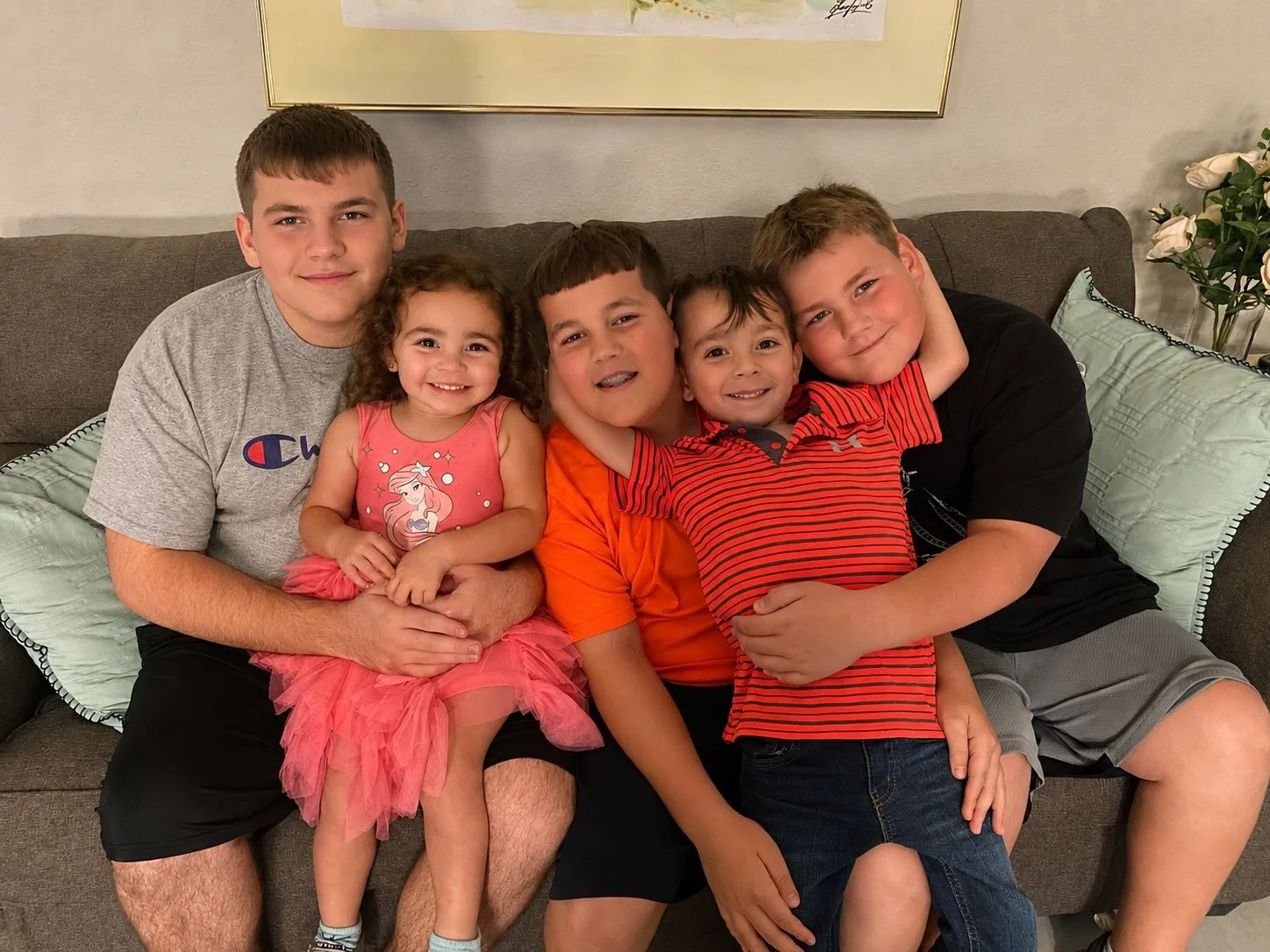
Sophie was three when her mother went to prison. She is six now. The three older boys live with their father; the two youngest live with her husband, with help from her mother. The two halves of the family rarely see each other. What follows is hers, written from FCI Tallahassee.
Tyler
21 · 18 when she went in
Tyler is my first child. I describe him as my perfect child. He is the one that taught me what love was. In fact, I always tell him he was my first love. He had this beautiful face with giant blue eyes. He used to repeat “daddy, daddy, daddy” like 20 times in a row whenever I said “mommy” to him. He was so funny.
I love to listen to my son play the guitar. I sometimes stare at him. He is so amazing. He calls me “mommy”. The last time he spoke to me, he was playing the guitar. He told me about his full school and work schedule and how he had to fit the gym into that schedule.
I am afraid of missing all the adult milestones with my son. He graduates in 2 semesters and I pray to God all the time that I do not miss his accomplishments. I am very open with my son, I tell him how special he is to me constantly and how proud he makes me. Something I never tell my son are my fears of not being there to be part of his life.
Her account is that Tyler is carrying the most of the five — that he was pushed to grow up very quickly and has not been able to have his college years the way he should.
Austin
17 · turns 18 in November
Austin is such a smart boy. He had these giant brown eyes and white hair as a baby. His smile, more like chuckles, would make even the most angry person smile. He has always liked building things and still does as of today: Legos, Minecraft, any building type games, as well as rival games. He is my one child that loves board games.
This child loves to cuddle. He is usually pushing the little ones away just to get right next to me to cuddle with me or hold my hand. He calls me “mommy”. The last time we spoke was last week. He told me about his girlfriend and how he is taking Piano 3 in school.
Austin was selected to be part of a dual enrollment program at his catholic school to graduate with his high school and college degree at the same time. He just told me he got an ACT score of 30 and has a full scholarship for when he graduates to go to the university. I am afraid of missing all the cuddles and love I used to receive from him. I am afraid not to be there for his high school/college graduation next year or for his 18th birthday later this year in November.
Connor
15 · 13 when she went in
Connor is such an amazing child. He was a little genius from early childhood. He loves sports and does very well in school. As a baby, he knew the names of all the Star Wars characters before he can say a full sentence and used to maneuver the lightsaber like a professional even while still in diapers.
Connor calls me “mommy”. The last time we spoke he told me about his basketball season starting and about his girlfriend. He even showed me pictures.
… I also fear missing his accomplishments as he grows up: graduation, basketball games, and honor rolls. I want Connor to know how special he is and how much I miss him. I wish more than anything that I can be there for him as he continues going into such a bright young man.
Mason
9 · 6 when she went in
Mason is the one that worries me the most because he is old enough to remember the search warrant and my arrest; both very traumatic experiences.
He was in the house on 4 November 2021 when agents came to the door with handguns drawn, and in the house again on 19 April 2022 when they came back before sunrise with rifles and took his mother out barefoot. He is the child in this family with a memory of both mornings.
He lives with his stepfather and his grandmother, five hundred and fourteen miles from the prison where his mother is held.
Sophie
6 · 3 when she went in
My Sophie is an amazing little girl. She is so much like me. Her sassiness does not even compare to how smart she is. She loves dancing and singing, wearing fake nails, and walking around in her mommy's shoes. As a baby, she was everyone's boss. Her brothers all catered to her and you can tell that she loved it. I used to sing the song “100 Years” to her when I would put her to bed as a baby and toddler and somehow she memorized it and has sang it back to me.
Sophie calls me “mommy”. Last time we spoke, she told me how much she misses and loves me. She also asked me when I was coming home. I responded to her telling her that “Mommy is fighting so hard to make it home to you and I promise you that you will be the first to find out when I am coming home once I know”.
I always prayed to God for a daughter and it devastates me that I am not with her to enjoy her. I want Sophie to know that I will never stop fighting for her.
The hardest conversation she has had to have with her daughter came after her hopes had been raised that she was coming home and then were not. She had to explain to a six-year-old that mommy was not coming home yet. Sophie cried and did not understand.
Elizabeth Hernandez · written statements provided by her family, 2026
Her mother says Connor and Sophie are the two most like her.
Before all of this, Sunday started with a very big breakfast, and she customized every child's pancakes — chocolate chips for one, blueberries for another, plain for another. Movies for the rest of the day, and the pool if the weather held. On days off she planned things: the Keys, the beach, a long weekend stretched to reach Disney or Universal. She saved for one trip somewhere cold each winter and a week in Siesta Key each summer. At Christmas all five children wore matching pajamas around the tree and the nativity set, and she burned holiday candles so the house smelled like it.
Her mother says she cooked her children a fresh lunch every morning before school — steak, fried rice, fresh cheeseburgers, lamb chops with her guava sauce. She tucked all five in at night. When one of them was sick she slept in their bed and stayed up with them. She was strict about two things: grades, and telling the truth.
What she makes now
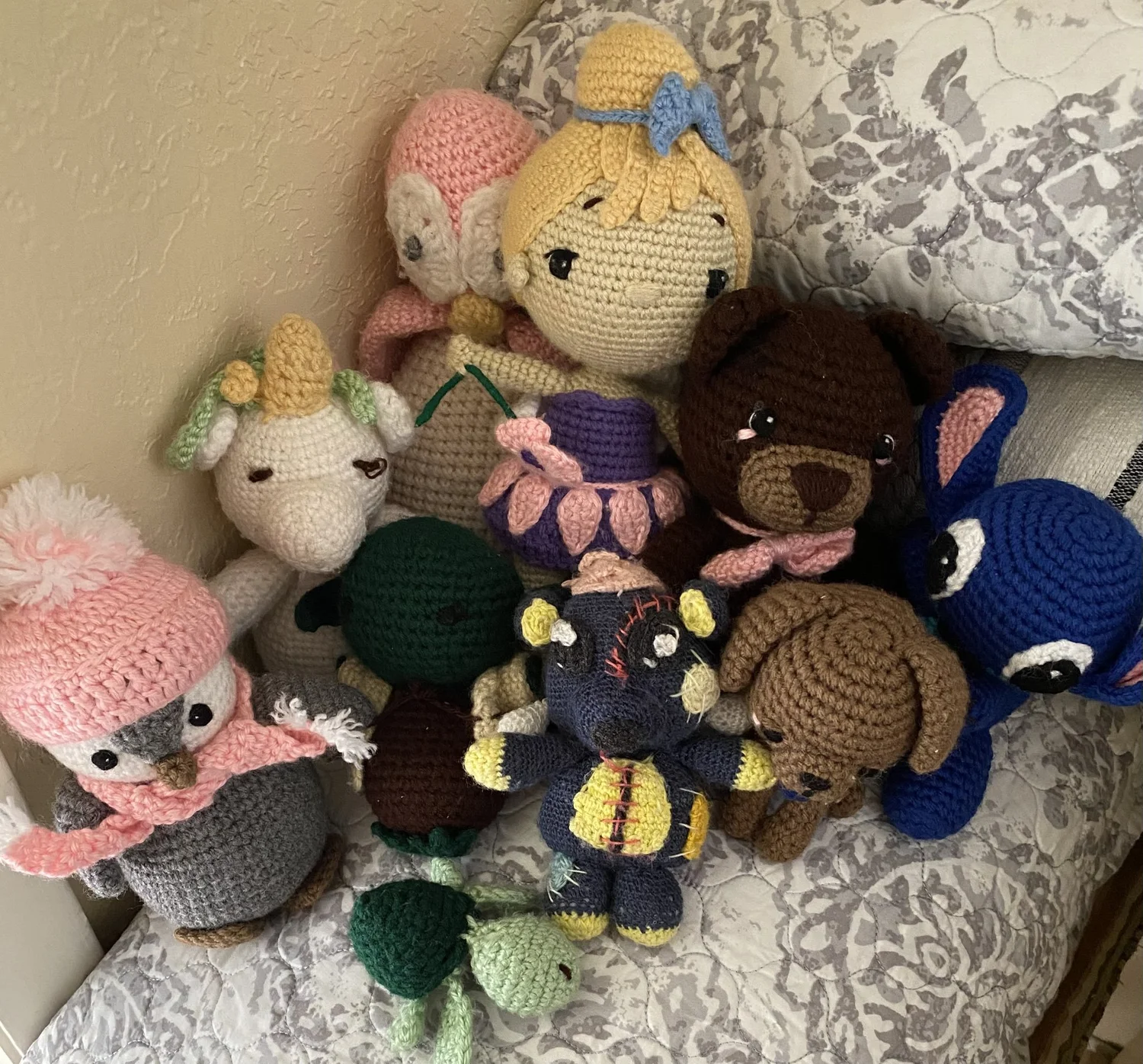
A penguin in a pink hood. A unicorn with a flower crown. A doll in a purple dress holding a flower. Two dogs, two bears, a pair of turtles.
She taught herself to crochet inside. She makes blankets, hats, purses and stuffed animals and sends them home. She has learned to work with ceramics as well, and recently mailed a box of what she made. The dolls arrive a few at a time. This is the pile so far.
She reads two things: the Bible and her legal documents. The other women on the unit come to her with health questions, because she is a nurse. On the first day of every month she asks herself whether this is the month she goes home. Sundays are the hardest day.
Five hundred and fourteen miles
She is held at FCI Tallahassee. Her mother and her children are in Homestead, 514 miles south — an 827-kilometer drive, roughly nine hours each way. It cannot be done there and back in a day, and her husband lives paycheck to paycheck. Her family says she has not seen her children in person in a year.
When she was held closer to home they came every single weekend for the allowed hour. Those visits were filled with over a thousand hugs and kisses and always ended with a game of teacher, where she described an animal and the children guessed which one. Goodbye was always the same: the children clung to her until they were physically removed.
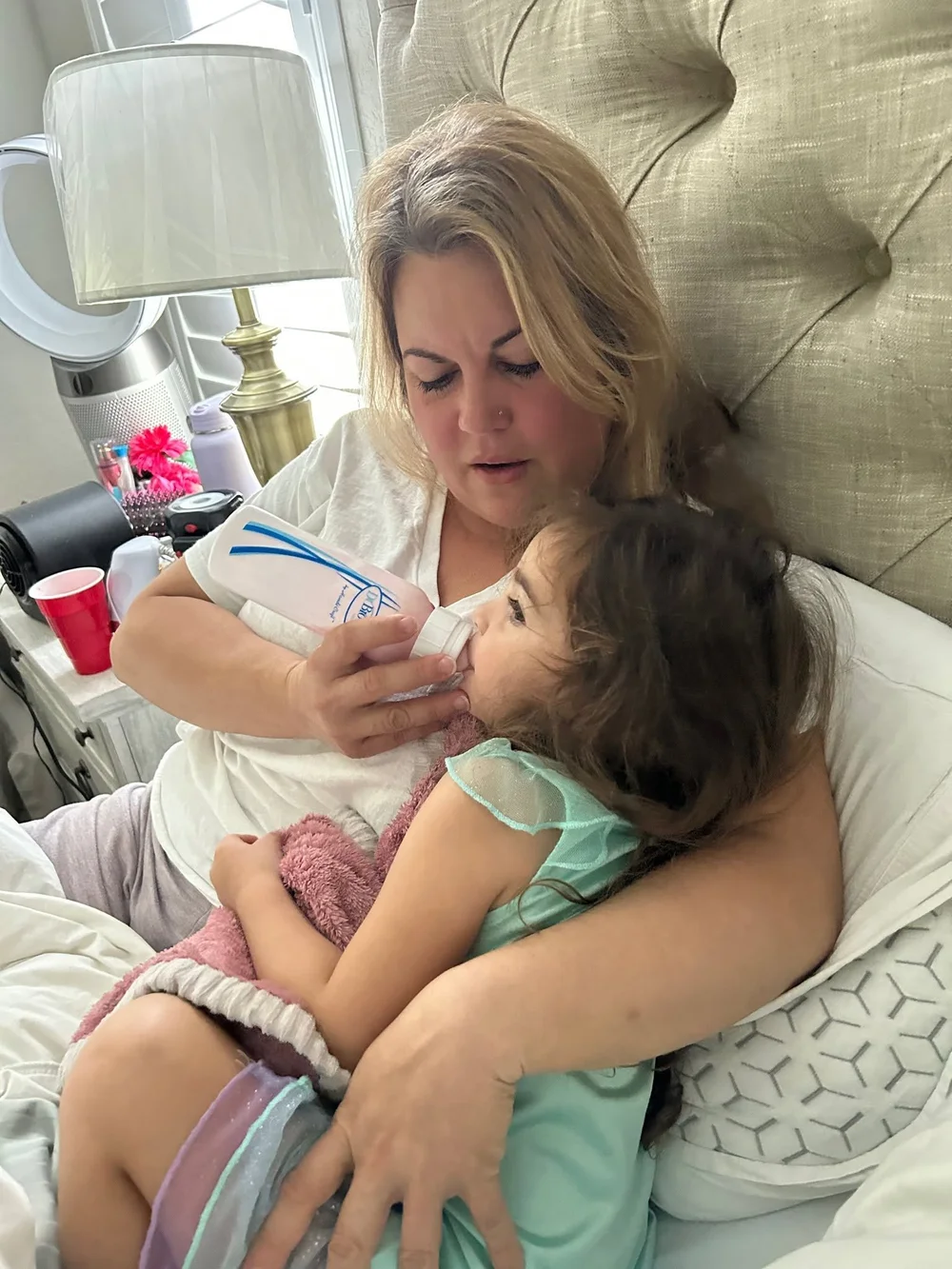
She met her husband at the hospital where they both worked — she was a nurse, he was a trauma paramedic. He has an autoimmune illness that requires intravenous infusions every six to eight weeks and a substantial number of medications. He is raising the two youngest children with her mother's help. On the phone the two of them mostly talk about the children, because that is what the time is for.
One of her five children has epilepsy. Asked what frightens her most, she does not name the sentence. She names that child's next seizure, and being nine hours away when it comes.
Happy Thanksgiving mom. I am grateful for you! Thank you for doing everything you have done for me my entire life. Thank you for helping raise my children who have a huge void to fill due to the absence of their mother. Thank you for all the emails, posts, letters, and phone calls you have made to help bring me home — I promise to you that they were not in vain! Someone will listen and will bring an end to this nightmare we are all going through. I love you!
Verbatim · Elizabeth Hernandez to her mother, 28 November 2024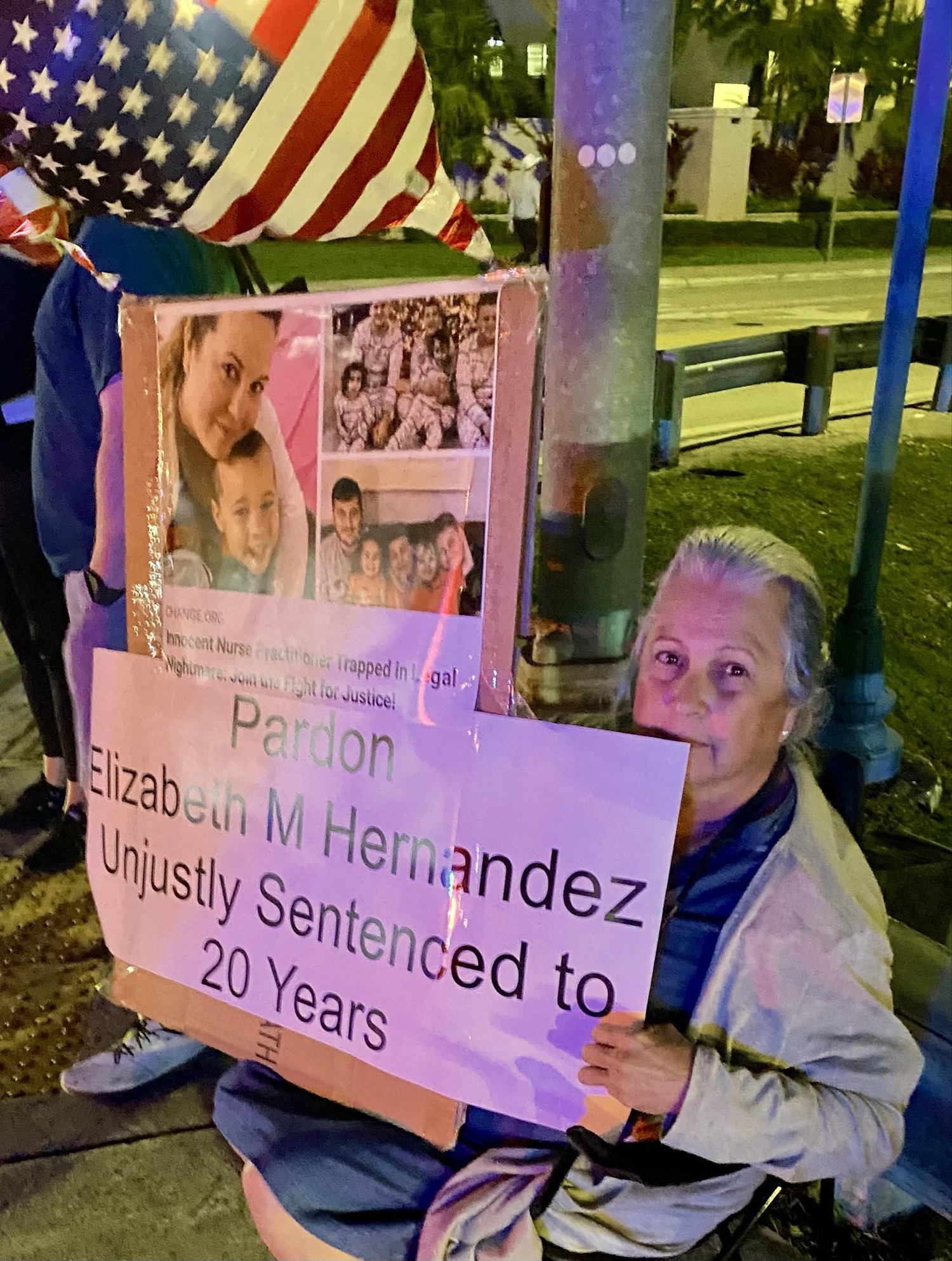
Her mother, Esther Pino, is retired. She is raising Elizabeth's youngest children. She started the petition that now carries more than five thousand verified signatures. She has driven to events for clemency advocates. And she has spent evenings outside Trump National Doral, on the ground beside a light pole, with a lantern, an umbrella, and a sign she made herself. The photographs taped to it are the same ones in this story — the five of them in matching Christmas pajamas. She has been doing this for over two years. Nobody is paying her, and nobody sent her.
I want people to know that I am a great mother, wife, daughter, sister, and aunt. I am dedicated to my family and held them all together. I do not deserve to be here. I did not know what others were doing and in no way would I have ever risked my family and my life. What I would tell someone reading my case is that I am not even close to the person they are describing.
I worked so hard to support my family and my strong work ethic left me working countless nights so that no patient would be put off for the following day. I loved being a nurse practitioner and I loved my patients. I thought I was helping them by providing them with something they needed to better their lives and their health.
The ordinary day I am waiting for is the day I hear the words “Hernandez, pack out, you are going home”. That will turn that ordinary day into the most extraordinary moment in my life.
Elizabeth Hernandez · written statement provided by her family, 2026A twenty-year sentence for a nurse practitioner with no prior record is a sentencing question, and reasonable people can argue it. Where she is held, and how far it is from five children who need her, is not a sentencing question at all. It is an administrative one, and it could be answered tomorrow.
A letter to the President of the United States
From Elizabeth HernandezFederal Correctional Institution · Tallahassee, Florida
Register No. 96666-509
Clemency petition No. 321508 · White House case No. 1000865
President Trump,
I am a mother of 5 amazing children. They need me more than ever now. I have been gone for almost 3 years. I have missed out on so many milestones and accomplishments. Please Mr. President, do not let me miss any more time with my babies.
I did not commit the crime I was convicted of. The narrative created by the prosecution is false. I ask that you review my case and file with all the evidence so that you can see that I had no idea the fraud that was happening after I completed the medical charts. I did my due diligence and used all the correct avenues to report everything the right way and they turned all of that against me. They used false testimony from their witnesses to emphasize the meaning of text messages without providing the entire message and on top of all that they withheld evidence that would have help exonerate me during my trial. The prosecutors “win all” mentality is the reason I have missed 3 years with my babies.
Before my incarceration, I was a dedicated loving wife and took care of 5 children. I helped them with school: proof reading essays and helping them prepare for testing. I was a “gourmet” cook. I always made them extraordinary and individual meals. I gave them love and support and met every single one of their needs. When they got sick, I would sleep with them tending to them however long their illness lasted. I used to look forward to picking up all my babies at school and spending our extra time watching movies cuddling on the couch while munching down on the “special popcorn” made by my husband.
I am a woman of God. I pray throughout the day and I speak to God more than anyone else in my life. More than anything, I trust God. I believe He put me here because He knows what a strong woman I am. He wanted me here so that I can change things that are not right. In a way, I am grateful for having had the opportunity to experience the pain I have been through, being separated from my children for a crime I did not commit. It is through this experience that I have learned humility, which is something I lacked. I plan to use everything I have learned to teach my children about God and to teach them the importance of humility.
Please Mr. President, give me the opportunity to go home to my children; give me a chance. I promise to live the rest of my life humbly and to the fullest and enjoy every single day as if it were my last alongside my family.
Elizabeth Hernandez
Reproduced in full and unaltered. Written by Elizabeth Hernandez at FCI Tallahassee and provided to us by her family, 2026.
The pardon power exists for precisely this. Mercy, in the constitutional sense — not pity for someone who did it anyway, but the remedy the Framers left in one man's hands for a criminal judgment the courts produced and cannot fix. The Supreme Court said so unanimously a century ago.
What clemency is for
Executive clemency exists to afford relief from undue harshness or evident mistake in the operation or enforcement of the criminal law.
The administration of justice by the courts is not necessarily always wise or certainly considerate of circumstances which may properly mitigate guilt.
Chief Justice William Howard Taft, for a unanimous Court · Ex parte Grossman, 267 U.S. 87 (1925)
Taft called the power “a check entrusted to the executive for special cases.”
The ask
We are asking for mercy. Not as a favor, and not as a request that anyone look away from what a jury found. Mercy is not the opposite of the law. It is the part of the law the Constitution put in one person's hands, because the men who wrote it knew the courts would not always be right and would not always be able to correct themselves. A president who cuts an excessive sentence is not suspending the law. He is finishing it. Have mercy, and uphold the law. In this case they are the same act.
What makes this a mercy case is not a feeling about her. It is in writing, in the Justice Department's own hand. In May 2021 the Department valued this conduct at one count and offered her three years. She declined to sign. In April 2022 the same office charged the same conduct at twenty, and she received all of it. The Department also asked for and obtained five years from the man its own indictment names as the person who recruited her, and who was ordered to repay $63.3 million. She reviewed charts for a flat fee, was ordered to repay $1.6 million, and is serving the statutory maximum.
Elizabeth Hernandez maintains her innocence and seeks a full pardon. This page does not rest on that. A commutation bringing her sentence into proportion with the Department's own charging and sentencing decisions would remedy the disproportion, and nothing about it requires anyone to disturb a jury verdict.
And, immediately and separately: designation closer to her children. That does not require anyone to reach a view on her sentence or her guilt. It is a Bureau of Prisons administrative decision. It costs nothing and it could be made tomorrow.
Americans grew up believing justice was the floor — the thing you could count on without asking, the thing that held whether or not anyone was watching. This record says otherwise. A three-year offer became a twenty-year sentence because a woman would not sign a paper. Two courts found error and neither gave a remedy. Her own licensing board found nothing to charge her with at all. Justice is not guaranteed in this country anymore. It has to be demanded, by name, one case at a time. This is one of them, and there are forty-two more.
Clemency petition No. 321508
White House case No. 1000865
Elizabeth Mercedes Hernandez · Reg. No. 96666-509
FCI Tallahassee · Tallahassee, Florida
The record
Held and being prepared for publication. The May 2021 plea agreement drafted by the Criminal Division's Fraud Section, containing the ten-year statutory maximum at paragraph 3, the stipulated intended loss of $15,170,133 at paragraph 13(b), and the stipulated restitution of $7,917,823 at paragraph 21; the transmitting correspondence of 17–25 May 2021 setting the three-day deadline and attaching the government's loss worksheet; and her counsel's reply of 24 May 2021 objecting that portions of the proffer could not be signed truthfully. Every figure attributed to those documents on this page is quoted from them. They will be posted here in redacted form.
Her mother started a petition for her release. It has more than five thousand verified signatures and carries Elizabeth's own account of the case, in her words rather than ours.
Read and sign her petition Change.org · her account, in her own wordsA note on quotation. Passages marked verbatim are exact text from a named transcript, opinion, filing, or dated message, with the source identified. Passages in italics attributed to Elizabeth Hernandez, and her letter to the President, are her own written words, provided by her family, reproduced without alteration except to correct spelling. An ellipsis marks one passage withheld at our discretion, concerning a minor child's medical condition; the fact itself appears on this page without naming the child. Figures attributed to the plea agreement, indictment or government correspondence are the government's own. Figures drawn from the indictment are allegations, not findings. Everything else attributed to a court, to counsel, to a witness, or to her family is a summary in our words.
If any passage on this page does not match the record, tell us and we will correct it.