
Before any of this
Who is Dr. Sanjeev Kumar?
A village in Haryana with no doctor in it. A tractor at seven. Forty-three peer-reviewed papers and the Mayo Clinic. Eleven years in Memphis operating on women every other surgeon had turned away.
Written and published by 250pardons.com. Dr. Kumar provided documents, photographs and written answers. He did not write this page and did not review it before publication. The case itself — the charges, the FDA policy, the tainted jury, the sentence — is set out on the main case page.
Dhakla
Dhakla is a village in Haryana, in northern India. Wheat, barley, sugarcane, carrots, potatoes. His father farmed and taught school — physical education, mathematics, science, sociology and civics, and was apparently good at all of them.
He was seven the first time he drove a tractor. His uncle put him at the wheel in an open field and left him there for four hours. He has described it since as the proudest he had ever been.
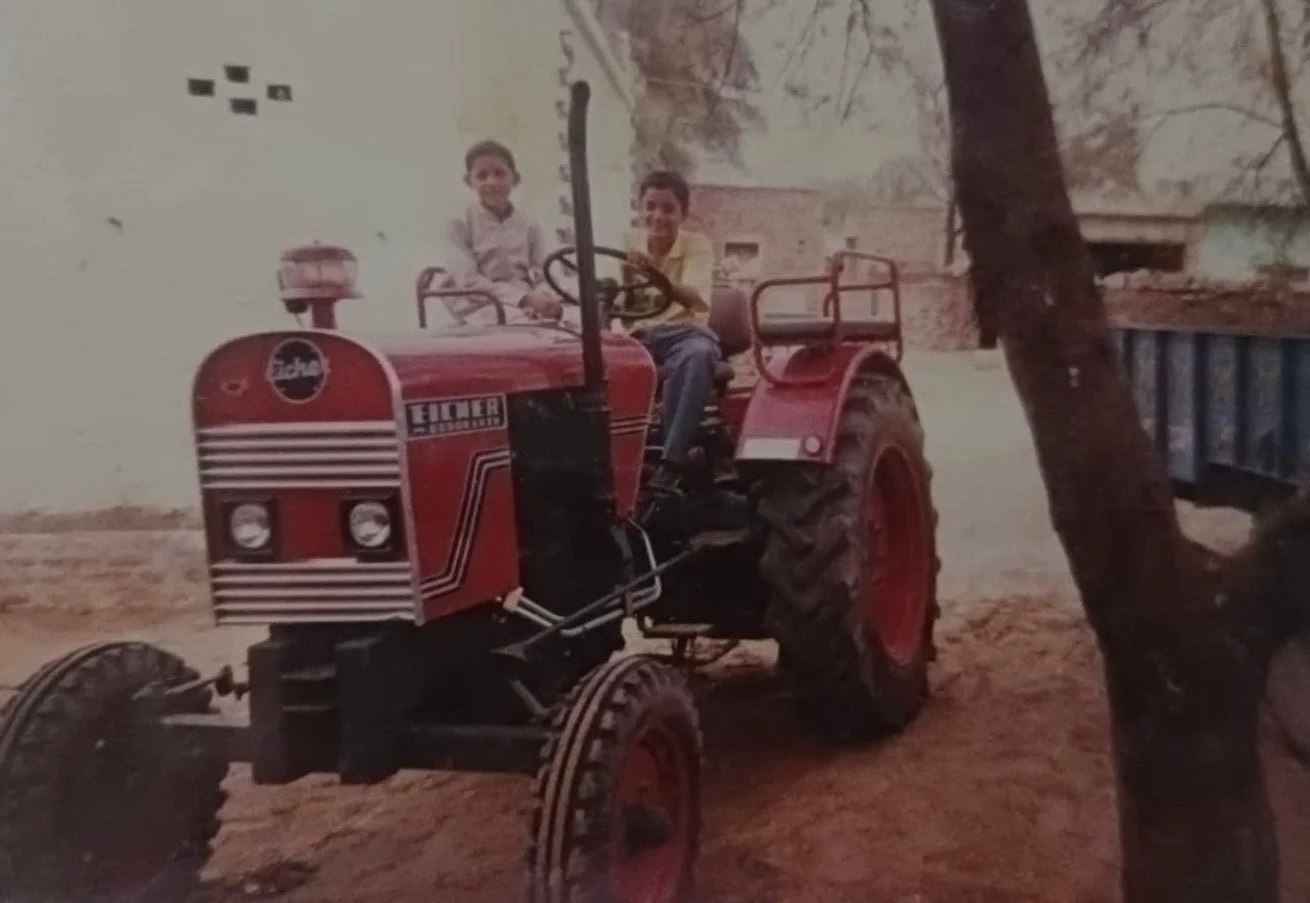
There was no doctor in Dhakla. A vaccination meant a long walk to find one, and the man at the end of that walk was the most respected person the boy had ever met. That is why he became a physician.
Why he became a surgeon is simpler and stranger. Surgery is done with the hands. It was the closest thing he could find to farming.
He was the first person in his family to go to university, and his father paid for medical school on a farmer’s and a schoolteacher’s money. He came to the United States as an international medical graduate, which is the hardest way in, and got to the Mayo Clinic by out-publishing everyone — forty-three peer-reviewed papers, two of them the lead article of the issue. He lived there on about $1,400 every two weeks: rent, gas for a Honda Civic, and hospital cafeteria food, because he was in the hospital anyway.
He ended up in Memphis, running an outpatient clinic on Poplar Avenue, open six days a week.
What the practice actually was
Before this case existed, Dr. Kumar was written up in a hospital system’s own annual report. Not by a publicist — by Baptist Cancer Center, in a document it published in 2017, seven years before the search warrant.
| From the Baptist Cancer Center 2017 Annual Report |
|---|
| In 2017 he was the eighth busiest surgeon in the United States using minimally invasive techniques for gynecologic cancers. |
| By the third quarter of 2017 he had performed 285 robotic procedures — 95 percent of those patients morbidly obese. Baptist described them plainly: patients over 400 pounds, routinely rejected as surgical candidates elsewhere because of the risk of wound infection, blood loss and pulmonary complications. They had almost nowhere to go. He operated on them. |
| He brought HIPEC — heated chemotherapy delivered into the abdomen during ovarian cancer surgery — to a region that did not have it. |
| He worked on the NCORP research grant, a National Cancer Institute program whose purpose is extending clinical trials to minority and underserved patients. Baptist’s was one of twelve such centers in the country and the only one in a seven-state region. |
Before he ever picked up a robot he was a researcher. Forty-three peer-reviewed papers, in Gynecologic Oncology, Obstetrics & Gynecology, the American Journal of Obstetrics and Gynecology, Cancer, the British Journal of Cancer. Two ran as the lead article of the issue. He is first author on roughly a third. His co-authors are the names that run gynecologic oncology at Wayne State and at the Mayo Clinic.
Two of those papers matter here more than the rest.
In 2011 he published on the gap between Black and white women in treatment and survival for vaginal cancer. In 2014 he published on racial disparities in uterine clear cell carcinoma. He documented, in the literature, that Black women were dying of gynecologic cancers at rates white women were not — and then he went to Memphis and opened a clinic six days a week that he says served one in four of the state’s Medicaid patients.
And in 2012 he was a co-author on a lead article in Obstetrics & Gynecology about what happens to women after a benign endometrial sample — who goes on to develop cancer anyway, and who needs watching. The procedure the Department of Justice prosecuted him over is a procedure he had already published research on.
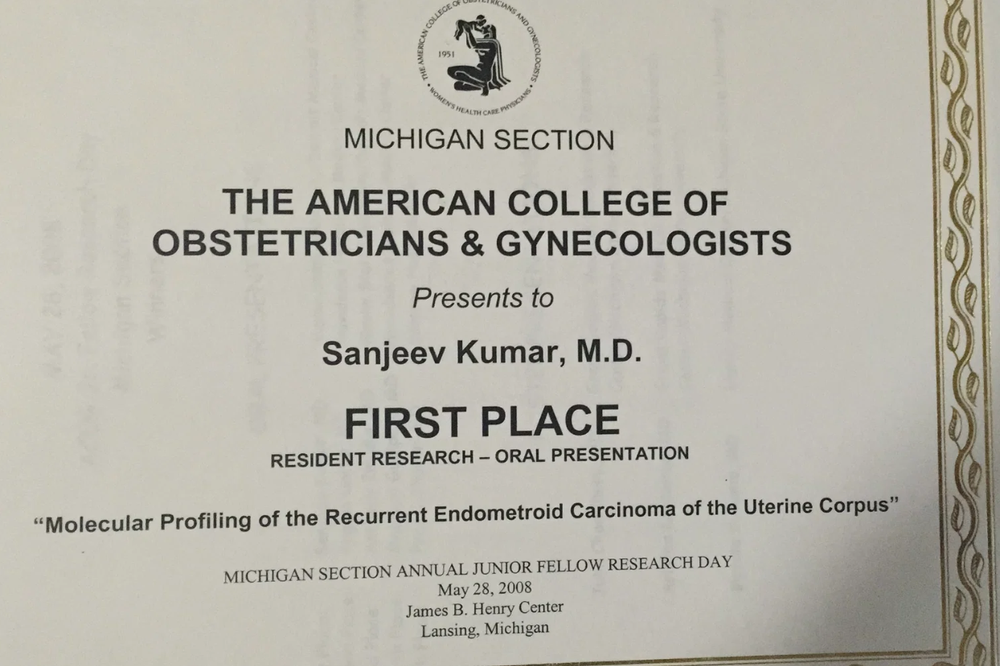
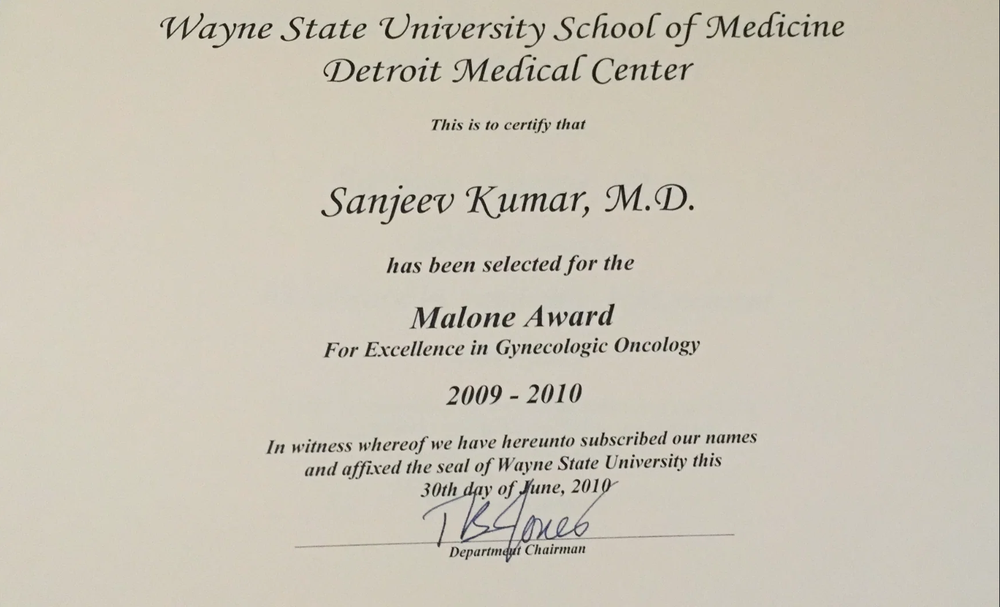
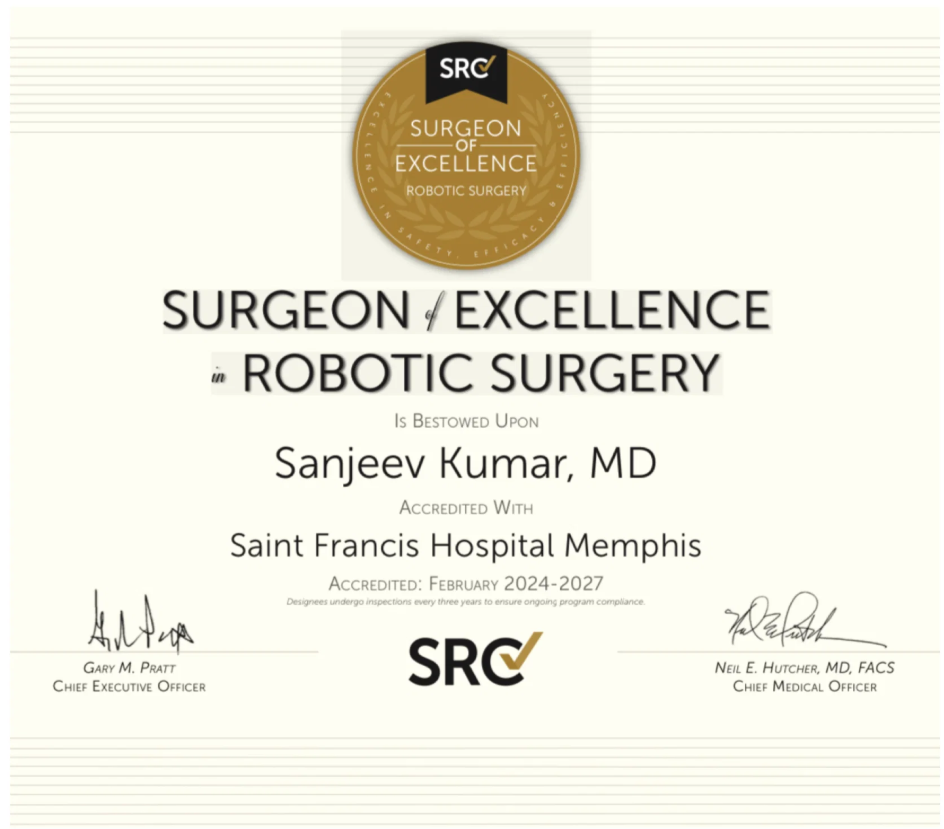
Sit with that last date. In February 2024 an independent accrediting body inspected his robotic surgery practice and certified it as excellent, for a term running to 2027.
On 16 April 2024 the government came through the door.
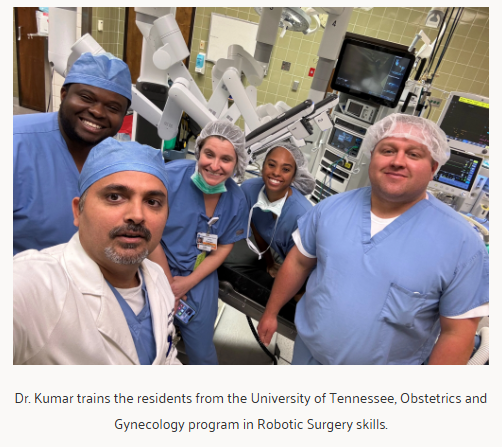
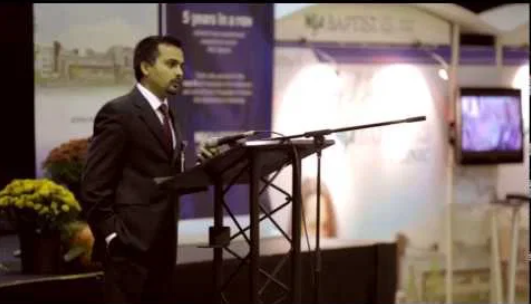
He was, in the ordinary way, a public figure in Memphis medicine. He taught in the operating room, he spoke at hospital events, and he gave public talks — a Baptist Memorial patient education evening on fibroid tumors among them. Local television covered his work twice, for the same practice the government later prosecuted: operating on women other surgeons would not take.
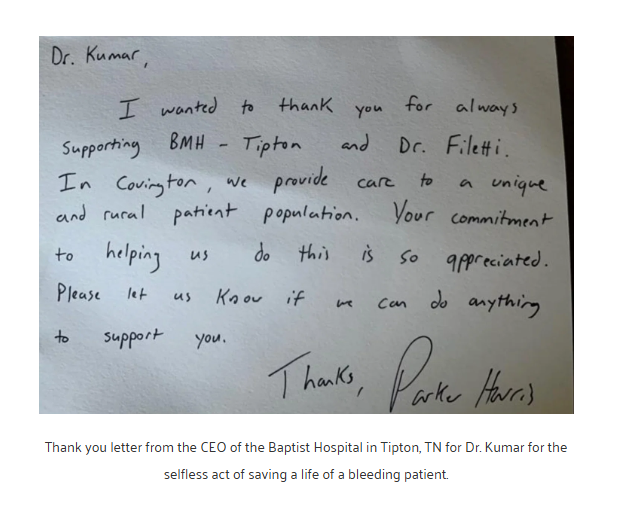
He also drove out to the rural hospitals. This is a note from the chief executive of Baptist Memorial Hospital-Tipton, in Covington, Tennessee — written by hand, thanking him for showing up for a patient who was bleeding.
What his patients wrote, before any of this
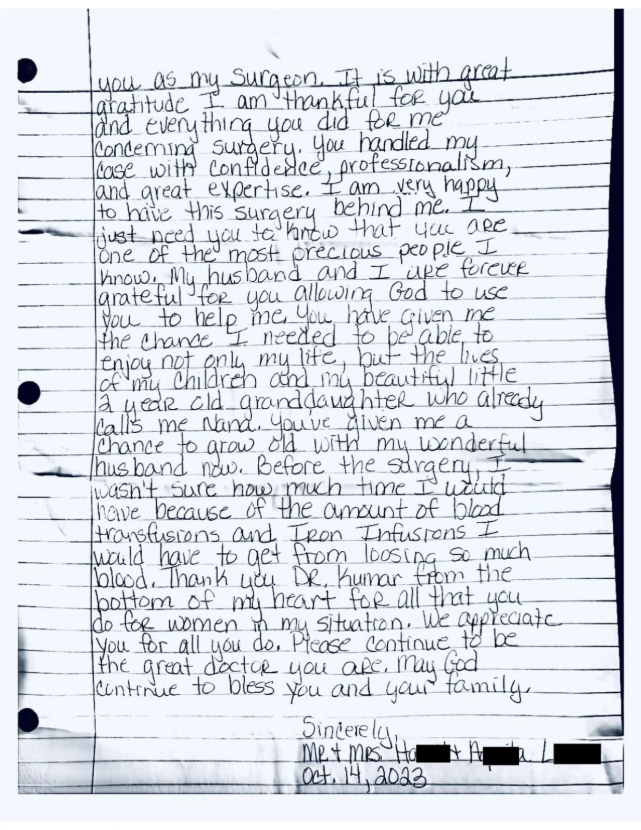
None of these were written for a clemency campaign. They were written to a doctor, by hand, by people who had no idea any of this was coming.
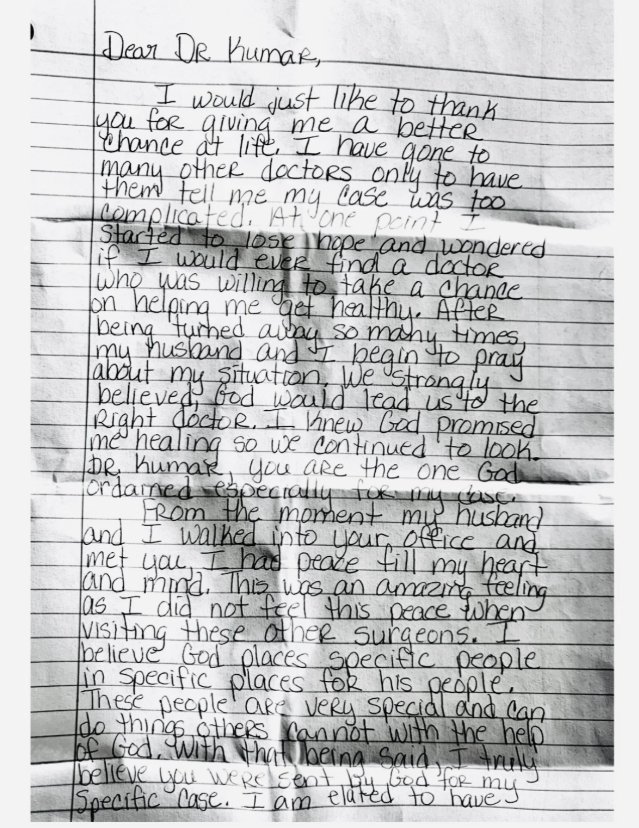
One woman wrote that she had been to many other doctors, and every one of them told her that her case was too complicated. She had started to lose hope of finding anyone willing to take a chance on her. She was losing so much blood that she was living on transfusions and iron infusions and did not know how much time she had. After the surgery she wrote to say she now expected to grow old with her husband and to know the granddaughter who calls her Nana.
The letter is dated 14 October 2023 — six months before the search warrant.
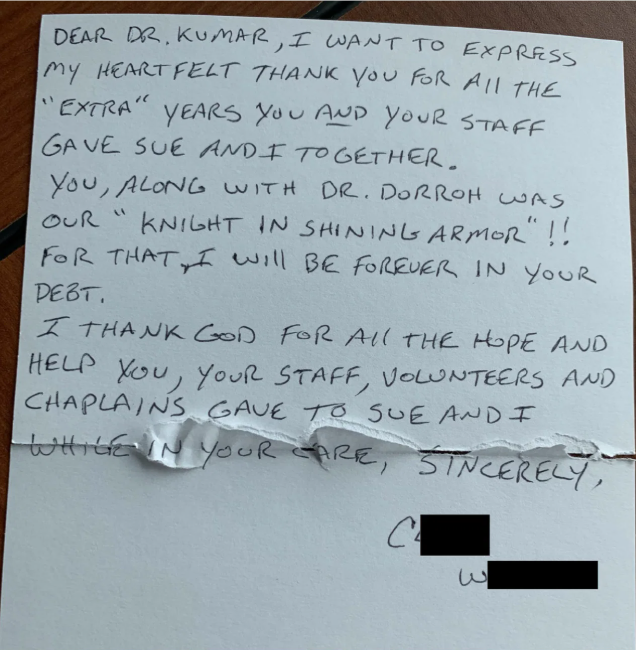
Another was written by a man about his wife, thanking Dr. Kumar and his staff for what he called the extra years the two of them got together.
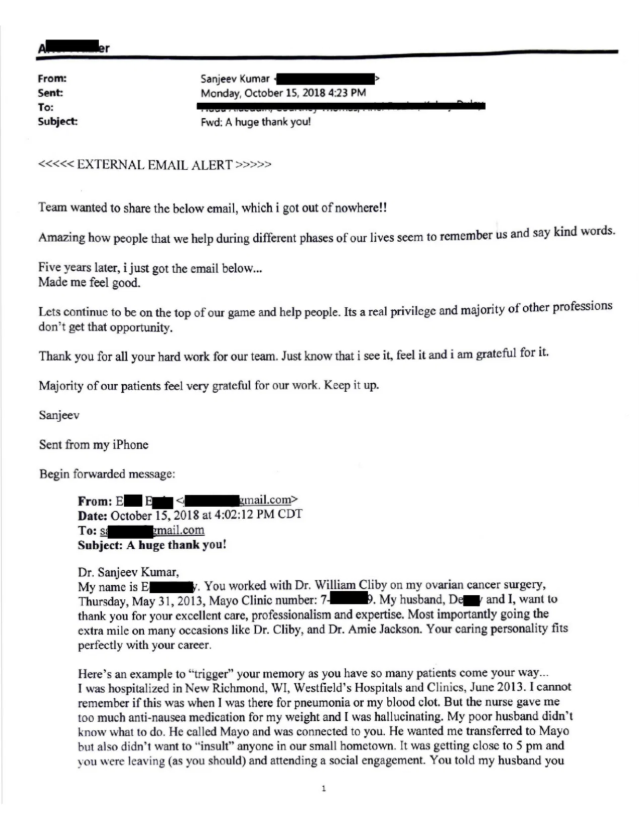
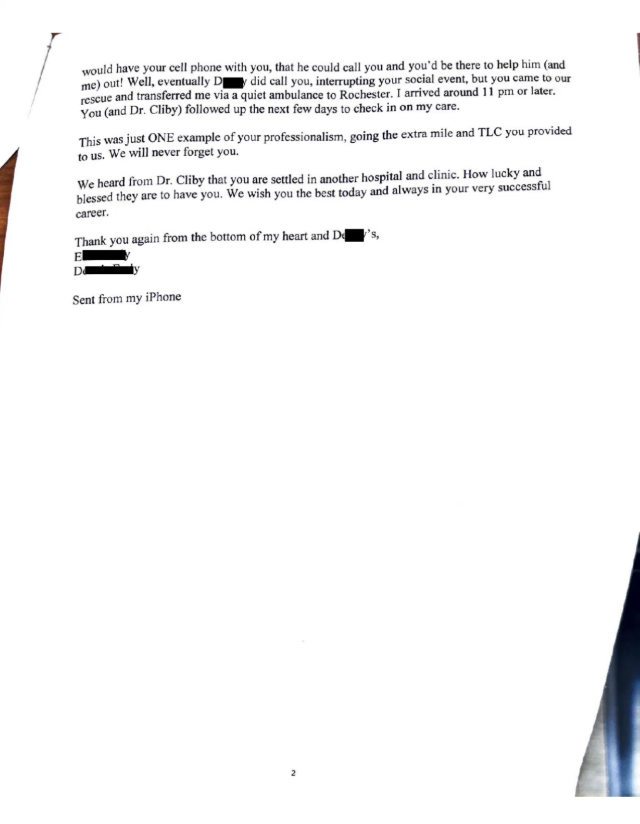
One arrived five years late. A woman he had helped care for at the Mayo Clinic in 2013 tracked down his email in 2018 to tell him what she remembered: she had been hospitalized in a small town in Wisconsin, hallucinating from too much anti-nausea medication, and her husband did not know what to do. It was near five in the evening and Dr. Kumar was leaving for a social engagement. He gave her husband his cell number, took the call in the middle of the evening, and arranged an ambulance to Rochester. She arrived around eleven at night.
He forwarded her message to his own staff with a note: amazing how people we help remember us and say kind words — keep it up.
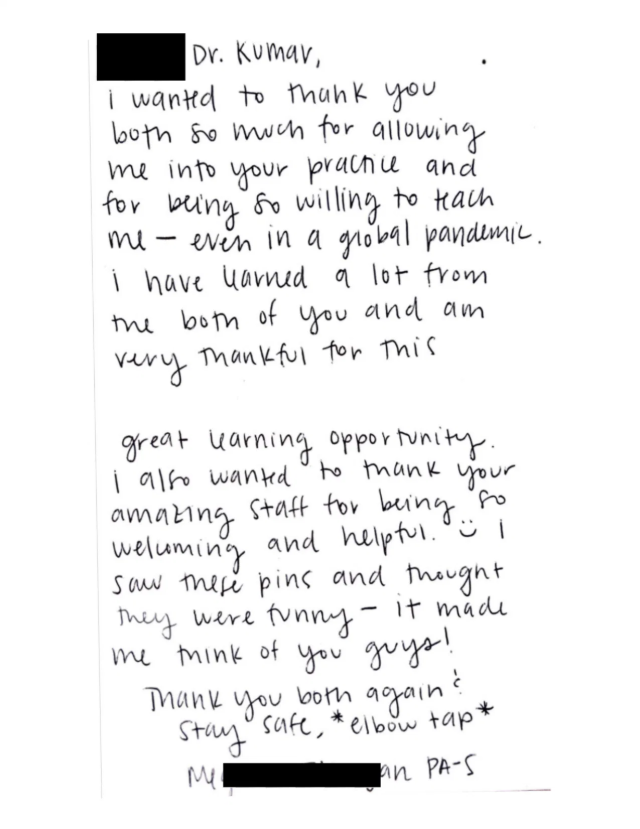
His trainees wrote too. A physician assistant student thanked him and his staff for taking her into the practice and teaching her even in a global pandemic — a year when most practices had closed their doors to students entirely.
His public Healthgrades profile carries 116 patient reviews. Ordinary people, writing in public, years before the indictment.
16 April 2024
He was in the middle of a robotic surgery when a text reached his phone: officers were at the clinic. His car had been broken into a few days earlier, so his first thought was a burglary — clinics get hit for prescription pads. He finished the case. Then the messages kept coming.
By 6:41 that evening WMC Action News 5 had a camera on the roadside marquee.
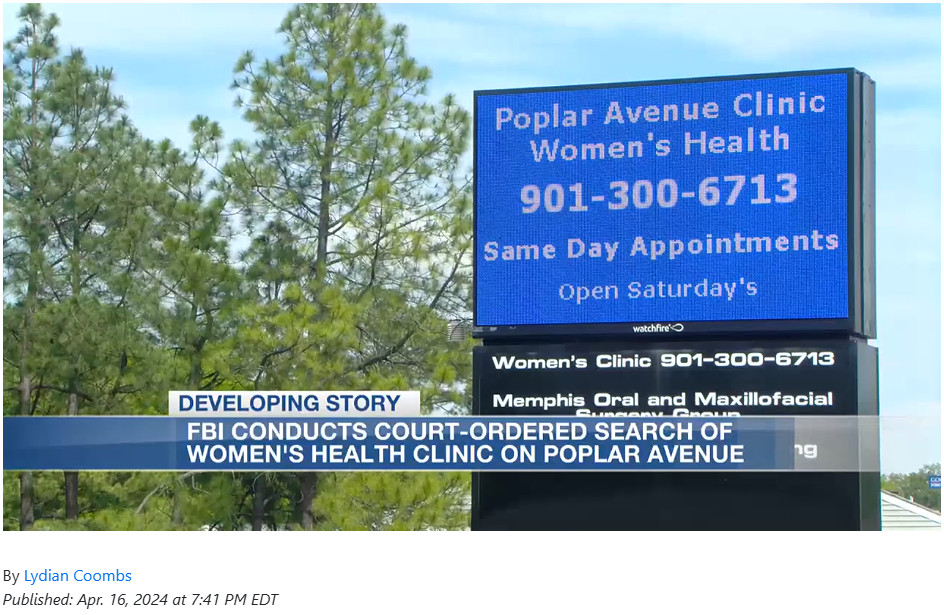
Two things are in that single frame. The chyron, which is accurate and neutral — a court-ordered search, which is what it was. And underneath it, the clinic’s own sign, still lit, still offering same-day appointments and Saturday hours, because at nine that morning it had been an ordinary Tuesday.
The story runs about a hundred words. It reports the search, gives the address, and states plainly that there was no word yet on what agents were looking for. It also notes that when the crew stopped by that afternoon the clinic still appeared to be open. Patients were still being seen.
Ten months later the Justice Department issued its press release, and the coverage turned.
The father who drove them to school
His wife runs the house. She is the one who enforces the rules, and he is not; he says he comes home deliberately unstructured, because he has spent the day inside the protocols of an operating room and cannot live in them too. So he is the soft one. He is the one who covers for the children when they are in trouble with their mother, and he is the one they come to.
The thing that was his, that nobody else in the family did, was the drive to school. Every morning. Then the drives to practices and lessons and tournaments. Their music in the car, sometimes his. He says they talked about the day, and about people worth admiring, and about how you build a business.
He did not hide his work from them. He showed them photographs of tumors he had taken out of women, and explained what each one would have done if it had stayed. They came to the clinic and were proud of it, and proud of how busy it was. He went into his son’s third-grade classroom with the robotic surgery equipment and let a room of eight-year-olds look at it.
When the search warrant was executed he was in the middle of teaching them two things: how to build a business, and how to prepare for medical school. He wanted them interested in surgery early.
The last ordinary weekend, the last one where nothing was wrong, they drove to a school tournament. In his own words: they had no idea what was in store for them.
His children were at school the morning of the search. They saw it on the news when they got home. His daughter said: Don’t worry papa, we will make through this. His son was too young to understand what he was being told.
Nothing has been hidden from them since, partly by choice and partly because there is no way to hide it. Legal calls happen on the car speakerphone with both of them in the back. They know the number.
They did not learn it from him. The sentence was reported before he could tell them.
His daughter wanted to be a doctor. She is now deciding between law and medicine, because watching this happen to her father shook her confidence in the profession. His son wants to build aircraft. Dr. Kumar says his son is the one who tells him to keep speaking about his innocence, and that both children are where he gets whatever he has left.
| The arithmetic | Now | At release |
|---|---|---|
| His daughter | 16 | 36 |
| His son | 12 | 32 |
| Dr. Kumar | 45 | 65 |
He does that sum himself, and then says the quiet part: that he may not be there at the end of it.
The drive to school — every morning, the one thing that was his — has already stopped.
What his father would have said
His father was a farmer and a schoolteacher in a village with no doctor in it. He paid for medical school for a son who was the first in the family to go. He died of a stroke in 2013, eleven years before any of this, and Dr. Kumar says the one mercy in the whole business is that he never knew.
He was asked what his father would have said if he had lived to see it.
Asked again, on another day, he put it in three parts. That his father would have been shocked. That he might have regretted sending his son to a country where a minority is an easier target.
And that he would then have told him to fight back.
That is the whole distance, from the tractor to here. A man paid a farmer’s money to send a boy out of Dhakla because there was no doctor in Dhakla. The boy became a cancer surgeon, went to the country that trains the best of them, and spent eleven years operating on women in Memphis whom other surgeons would not take.
His brother still farms. His sister practices law in India, and cannot make the American process in this case fit anything she knows about law. Both of them tell him the same thing every time he calls: that justice will get there in the end.
His publication record
Vaginal cancer disparities: PMID 21497383. Endometrial cancer after benign sampling (lead article, Obstetrics & Gynecology, Nov 2012): PMID 23090515. Lymph node metastasis in malignant germ cell tumors (lead article, Gynecologic Oncology, Aug 2008): PMID 18571705. Metformin and ovarian cancer survival (Cancer, 2013): PMID 23208739. Also: International Journal of Gynecological Cancer.
Coverage before the indictment
WREG Memphis — “Memphis surgeon makes robotic hysterectomies possible for women of all sizes” · Action News 5, 7 February 2019 · Baptist Memorial Health Care — public education event on fibroid tumors · WMC Action News 5, 16 April 2024.
A note on sources. The tractor photograph was provided by Dr. Kumar. Names have been redacted from patient and staff correspondence. The television news frame is reproduced with attribution to WMC Action News 5 and is linked to the original story. Statements introduced with he says are his own account.
If any passage on this page does not match the record, tell us and we will correct it.