
43 Americans · Case 1 of 43
Ephraim "Ed" Rosenberg
Named in the indictment as Ephraim Rosenberg; known throughout the industry as Ed. Seller advocate, Brooklyn, New York. Founded ASGTG, the largest independent community of Amazon third-party sellers in the world. Named first of six defendants in a conspiracy the Justice Department announced at $100 million. The government that charged him recommended he serve no prison time. No victim has ever come forward. No restitution was ever ordered. No seller account was ever suspended over anything he did. His community has doubled in size since the indictment. And six years on, the sellers who know that industry still do not recognize the crime that was announced.
Ephraim "Ed" Rosenberg is Case No. 1 of the 43 Americans. This is 43 Americans, a record of forty-three federal criminal cases in which the public court file does not match the account the Justice Department gave the country. Every case here is documented from filings rather than from a summary written by a supporter, and every page prints the facts that cut against its subject. Ed Rosenberg built this record after his own conviction, and he is the first case in it. Read the other forty-two.
Written and published by 250pardons.com. Ephraim Rosenberg provided documents and answered questions for it. The arguments, characterizations and conclusions are ours, not his, and not his lawyers'.
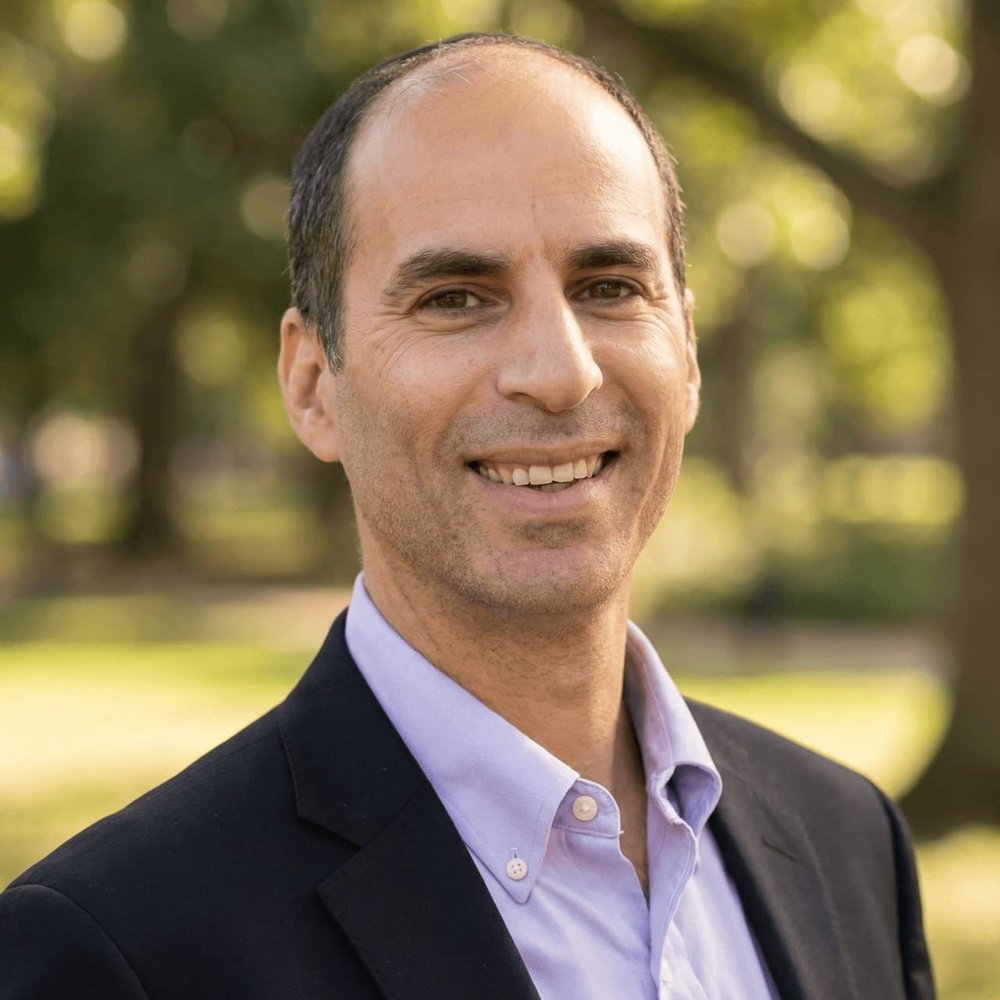
In September 2020, the Department of Justice announced a $100 million conspiracy. Ed Rosenberg was named first.
Federal agents came to the family's Brooklyn home at six in the morning, carrying rifles. Ed was not there. His wife was. So were his children. They were frightened.
The agents left with the family's computers. Three storage devices. A desktop. Three laptops.
When Ed told his family what the government said he had done, they thought he was joking.
Two and a half years later, the same Department of Justice — joined by the United States Probation Office — told the court that Ed Rosenberg should not spend a single day in prison.
Everything you need to know about this case lives in the space between those two facts.
What he apologized for was not what the government announced
Before he was sentenced, Ed Rosenberg published a public apology. It was a written statement, posted beneath an eleven-second video in which he says only that an important message follows and asks people to read it. Here is what he admitted, in his own words:
"For a time, some years ago, I began to obtain and use Amazon's internal annotations — Amazon's private property — to learn the reasons for sellers' suspensions, in order to assist them in getting reinstated, if possible. On some occasions, I paid bribes, directly and indirectly, to Amazon employees to obtain annotations and reinstate suspended accounts. These actions were against the law.
I should not have engaged in any of this conduct. I am sorry to have done these things. I very much regret doing them."
— Ephraim Rosenberg, written public apology, March 2023
That is the whole of it. Notes, and payments to get them.
It is also, word for word, the whole of what his plea agreement says he did. The statement of facts he signed under oath describes paying for confidential account information. Nothing more.
A statement of facts is the section of a plea agreement listing exactly what the defendant admits. It is the legal boundary of a guilty plea. Anything outside it was not admitted.He did not set out to recruit an Amazon insider. Annotations were traded by anonymous accounts across Telegram, Facebook groups and seller forums, and that is where he bought them. The Justice Department later identified one of those accounts as a Seattle-based Amazon employee, and said Rosenberg paid that person more than $18,000 over a three-year period. He has never learned the person's name.
His plea agreement puts total bribes above $100,000 — but the agreement's own words are "by or through him or his co-conspirators." That is the figure for all six defendants, not for Rosenberg alone. And he did not sign that agreement and then hope for probation. The recommendation of no prison time was inside the bargain before he signed it.
Now compare that to what the public was told.
The Justice Department's 2020 press release described a conspiracy worth more than $100 million. Its 2023 sentencing release said Rosenberg purchased forged supplier documents — paperwork faking where products came from.
Neither appears in his plea. Neither appears in his apology.
The $100 million figure comes from the indictment, which defines it plainly: the combined economic impact of the entire six-defendant case, made up mostly of sales that third-party sellers earned after their accounts were reinstated. It was never a loss. It was never Ed Rosenberg's. It was the revenue of other people's businesses, added together.
And the forged documents were somebody else's conduct. The indictment makes that allegation against all defendants collectively. It names Rosenberg individually in nine separate acts — none of them involving an invoice. Rosenberg says those nine were selected from years of correspondence and presented without the context around them. The Justice Department's own announcement in the same case attributed supplier-document forgery to a different defendant, by name.
"I didn't apologize for a $100 million scheme. I apologized for using some notes. If they say using notes makes you part of a 'conspiracy', then so be it — I can't argue with that. But the yardstick used at the end would have implicated the entire seller community, with ASGTG being the most pro-rules entity in the community. An extreme injustice."
— Ephraim Rosenberg
The record supports him. He admitted what he did — obtaining internal notes, and paying for them. He has never taken it back. What he has never been able to do is get anyone to correct the difference between that and the headline.
What the accusation was worth
A $100 million headline in 2020.
By the time of sentencing, the government's own guidelines calculation put the value of the bribes at between $95,000 and $150,000 — across six defendants, over three years. His final offense level was 13, the low end of the federal scale.
And no restitution was ordered. None.
Restitution is money a court orders a defendant to pay back to the people he harmed. It requires an identified victim and an identified loss.This was not for lack of trying. His plea agreement contains an unusually broad restitution clause. He agreed the court could order restitution beyond the crime he pleaded to. He agreed the government could present evidence of losses from all known conduct, charged or not. He agreed to disclose every asset he and his wife owned, under penalty of perjury, and to hand over tax returns and credit reports.
The government reserved every avenue available to it.
It collected nothing.
Amazon filed a victim impact statement. It told the court it had been harmed, that its selling partners had been harmed, that customers had been harmed. It asked for prison.
It received nothing. Not one dollar was ordered paid to Amazon. Not one dollar to any seller. Not one dollar to any customer.
The court imposed a $100,000 fine — payable to the United States Treasury, which is where fines go when there is no victim to compensate.
In a case announced to the world as a $100 million conspiracy, no identified person or company was ever found to have lost anything a court could order repaid. Six years on, no victim has ever come forward.
And by the end, the prosecution's own sentencing submission described the defendant it had spent three years pursuing:
Rosenberg operates a legitimate consulting business that has served many seller clients through legal means, with the conduct charged in this case constituting a significant aberration from those legal business activities.
That is the government of the United States, in its own filing, saying that the man it indicted as the centerpiece of a marketplace conspiracy runs a legitimate business, and that what it charged was an aberration from it.
Prosecutors do not write sentences like that about people they believe are guilty of what they charged.
Rosenberg's own position is that the conduct the government called an aberration looks different with the surrounding context restored — which turns even the aberration into something else.
There was no deal. He informed on no one.
When a federal defendant walks out of court without prison, there is usually one reason: he gave the government someone else.
Prosecutors can ask a judge to go below the normal sentence when a defendant provides substantial assistance — testimony or information used against other people. It is the most common route to a sentence with no prison time.Ed Rosenberg's plea agreement contains no cooperation provisions. No substantial-assistance motion was ever filed. He testified against no one. He named no one.
He received probation anyway — recommended jointly, in writing, by the prosecutors who indicted him, four months before he was sentenced.
Meanwhile the government told the court that a different defendant, Joseph Nilsen, was the most culpable of the group, and described him as supplying the pipeline of illicit services to his own clients and to Rosenberg's.
The light sentence was not purchased. It was the government's own measure of what this actually was.
What it costs to defend yourself against a corporation and the government at the same time
In an ordinary federal case there are two sides. The government has the evidence, and the law requires it to give the defense a copy.
This case had a third party.
Almost everything in it — the account records, the internal notes, the employee emails — belonged to Amazon. Amazon was not a defendant. Amazon was not on trial. Amazon was the company that had reported him, and it owned the file.
So his lawyers could not simply ask the prosecutor for the evidence. They had to go through Amazon's lawyers. What was produced, when, and under what conditions all ran through the company that had started the case.
Every hour of that was billed.
Amazon's legal department is one of the largest in the world. Ed Rosenberg was paying by the hour, out of his own pocket, in installments.
He reports spending more than two million dollars on his defense, continuously, from the day of the indictment to the day of sentencing. The portion documented here covers four months and two of his three law firms: $154,267.50.
In June 2023 alone, nearly $42,000 of that went to drafting a single document — the memorandum asking the judge not to send him to prison. He was paying it down in pieces: $1,500, $3,000, $2,000, $5,000, whatever he had that week. A week before sentencing he still owed one firm $62,632.50.
His case ran two and a half years. Five times his lawyers signed agreements postponing it. Four times the deadline for filing motions was pushed back.
A motion is a formal request asking a judge to rule on something — to throw out evidence, to dismiss a charge, to force the government to explain itself. It is how a defendant fights back before trial.Not one substantive motion was ever filed. Nothing challenging the search of his home. Nothing challenging the charges. The deadline to file them was extended four times and never used.
On 27 March 2023, his lawyers asked the court for one more extension.
Three days later he pleaded guilty. The request was withdrawn as moot. Rosenberg estimates that carrying the case all the way through a trial would have run into the tens of millions of dollars.
Why almost nobody fights
Federal judges sentence by a formula. Every offense gets a number, and the number sets the range of prison time.
One of the few things that lowers the number is called acceptance of responsibility. Admit what you did, and the formula moves down. For Rosenberg it moved from 16 to 13 — the difference between a range that starts in prison and one that allows probation.
So contrition is not only a moral question in a federal case. It is a term of the deal. And the government decides whether you have shown enough of it.
Almost nobody tests this. Roughly 90% of federal cases end in a guilty plea. Fewer than 3% ever reach a jury.
Arthur Andersen fought. The accounting firm was convicted, and it was destroyed — 28,000 jobs gone. Three years later the Supreme Court reversed the conviction unanimously. The vindication arrived after the firm no longer existed.
Ed Rosenberg has six children. He did the math — and guaranteed probation was what let him get his life back.
What Amazon's own contract says
Here is the world Ed Rosenberg was operating in, in Amazon's own words. From the Amazon Services Business Solutions Agreement as it stood in March 2019:
We may terminate or suspend this Agreement or any Service for any reason at any time by notice to you.
For any reason. At any time. No obligation to say why.
The word appeal does not appear anywhere in that document.
Read that again. A seller with employees, a warehouse, and millions of dollars of inventory could be shut off from their entire livelihood — permanently — and Amazon owed them no explanation and offered them no hearing. Not a slow hearing. Not an inadequate hearing. None.
Read it — Business Solutions Agreement, archived 13 March 2019

Web capture of the Amazon Services Business Solutions Agreement, archived by the Internet Archive on 13 March 2019. Scroll inside the panel to read the full agreement. Verify at web.archive.org
Then Amazon changed it
By the version archived on 1 December 2020, that sentence is gone.
Termination for convenience now requires thirty days' advance notice. A material breach now carries a seven-day cure period, which Amazon may shorten only where the breach exposes it to third-party liability. And Amazon now commits to stating a reason:
We will promptly notify you of any such termination or suspension via email or similar means including Seller Central, indicating the reason and any options to appeal, except where we have reason to believe that providing this information will hinder the investigation or prevention of deceptive, fraudulent, or illegal activity, or will enable you to circumvent our safeguards.
Those changes came afterward. They are also an admission of what the earlier version was. Amazon rewrote the terms Ed Rosenberg's sellers had been living under — the ones that let it close a business for any reason, at any time, and say nothing.
And read the revised language closely, because three things survive it.
Amazon may still suspend or terminate immediately where it determines an account may be used for deceptive, fraudulent or illegal activity, or that a seller's use of the Services might harm other sellers, customers, or Amazon's own legitimate interests. Not that it has. That it might.
The duty to give reasons carries an exception Amazon applies on its own judgment, and the seller is not told when it has been applied.
And there is still no appeal. The agreement mentions "any options to appeal." It does not create one, define one, set a deadline for one, or promise a human being will read anything.
And the provisions letting Amazon withhold a seller's money were not changed at all. In both versions, Amazon may in its sole discretion withhold any payments to a seller for as long as it determines a risk persists — and may withhold them permanently where it determines an account has been used for deceptive, fraudulent or illegal activity, or to repeatedly violate its policies. Amazon rewrote how it ends a seller's business. It did not change what happens to the seller's money.
Read it — Business Solutions Agreement, archived 1 December 2020

Web capture of the Amazon Services Business Solutions Agreement, archived by the Internet Archive on 1 December 2020. Scroll inside the panel to read the full agreement. Verify at web.archive.org
Both panels above are screenshots of Internet Archive web captures, not of Amazon's live site. Each links to the archive so any reader can confirm the text independently. Amazon's current agreement is published at Seller Central and has changed again since 2020.
This is the company that went to the Department of Justice about transparency.
The United States government says Amazon's sellers live in fear
Three years after Ed Rosenberg was indicted, the federal government filed its own case about how Amazon treats the people who sell on its marketplace.
In FTC v. Amazon.com, the Federal Trade Commission and a coalition of state attorneys general allege that Amazon illegally maintains a monopoly. Buried at paragraph 258 is a description of what that means for a seller:
FTC v. Amazon.com, Inc., No. 2:23-cv-01495-JHC (W.D. Wash.) — Second Amended Complaint ¶ 258, at 82
Many sellers stay on Amazon despite unfavorable views of the company, because there are no viable alternatives. Seller forums are filled with complaints ranging from abrupt and arbitrary account suspensions to inventory seized with no recourse. One seller explained that they cannot leave — and that Amazon knows it.
The complaint then cites an internal Amazon study. According to Amazon's own research, its sellers live "in constant fear" that Amazon will arbitrarily cut off their ability to sell — putting, in the study's words, their businesses and their livelihoods at risk.
Amazon denies the allegations. In September 2024, Judge John H. Chun refused to dismiss any of the federal claims, holding they were sufficient to proceed. The case is headed to trial. Nothing has been proven.
But this much is on the public record: the United States government alleges that Amazon knew its sellers lived in fear of arbitrary suspension — and that Amazon's own researchers told the company so.
That is the marketplace the sellers who came to Ed Rosenberg were trying to get back into.
If Amazon has suspended your seller account
A lot of people reach this page looking for something else entirely: why Amazon suspended their seller account, how an Amazon suspension appeal actually works, why their funds are being withheld, or what "account health" means when nobody at Amazon will explain the decision. Here is the short and accurate answer, because it is the reason this case exists at all.
Under the Amazon Services Business Solutions Agreement, Amazon can suspend or terminate a selling account, block a listing, and withhold a seller's money at its own discretion. The 2020 revision added notice and a stated reason, with exceptions Amazon decides for itself. It still creates no appeal — no deadline, no defined process, no guarantee a human being reads what you send back through Seller Central. And during the years covered by this case, the internal notes explaining why an account was suspended — Amazon's annotations — were not shown to the seller at all. Reinstatement meant guessing at the reason, in writing, repeatedly, while the inventory sat and the payroll came due.
That gap is the entire industry Ed Rosenberg was working in, and it is what the Justice Department prosecuted him out of. If you sell on Amazon, or used to, and a suspension took your business — or if you worked inside Amazon's seller performance, account health, or seller support teams in any year — we want to hear from you. We do not publish names without permission.
What Ed Rosenberg actually did
He built the thing Amazon wouldn't.
ASGTG — Amazon Sellers Group Telegram — grew from a WhatsApp group into the largest independent community of Amazon sellers in the world, with a Facebook group alone topping 83,000 members, known worldwide as the voice of the seller. Its stated mission was a White Hat pathway: follow the rules, use official channels, don't touch the black-market consultants selling sabotage and forged documents.
White Hat means playing by the rules. Black Hat means cheating — bribes, forgeries, sabotaging competitors. The seller community uses these terms constantly. ASGTG's entire identity was built on the first one.He ran a paid consulting practice, the way any consultant does. But the escalations were different.
When a legitimate seller had exhausted every appeal Amazon offered and still had no answer, Rosenberg would review the file and send it to Amazon executives who had known him for years. They did not reinstate accounts. They told the right team to look again. Amazon made every decision.
He did roughly 1,200 of these.
He never charged for a single one — specifically so no one could claim access to Amazon's leadership was for sale.
Amazon executives attended his events. He was invited to Amazon's Seattle headquarters more than once. He organized the #WorkWithUsAmazon petition, which drew more than 12,500 signatures and forced direct engagement with Amazon leadership.
He was the most effective organized voice sellers had ever had. And he was aimed squarely at Amazon's suspension practices.
Then he was indicted.
Three doors
Between 2016 and 2020, a legitimate American business wrongly suspended by Amazon had three options.
The three links below are Ed Rosenberg's own writing about each door, published on his blog. They are his account, not this page's.
Door one: shut down. Fire the employees. Liquidate the inventory. Go bankrupt. Sellers took this door constantly — a ten-year seller destroyed over an authentic Adidas replica ball that an algorithm read as counterfeit, a seven-dollar item; a business owner facing the layoff of nine employees; a seller in China who knelt in front of a camera holding hand-lettered signs begging for her money back after 576 days.
Some sellers did not survive it. ASGTG's inboxes carried messages from people describing suicidal despair after losing everything to an automated decision no human had reviewed. Rosenberg answered them personally. To one, he wrote: Amazon doesn't decide your worth.
Door one, in Ed Rosenberg's words: the sellers who didn't survive it →
Door two: hire a black hat. Thousands of illicit consultants sold insider reinstatements — real bribes, forged documents, sabotage of competitors, corrupted Amazon employees. Before ASGTG, this was the most common route a desperate seller took, and it built an entire underground industry.
Door two, in his words: what the black hat market actually looked like →
Door three: ASGTG. Bring the case to Ed Rosenberg, who would vet it and — if it held up — put it in front of Amazon executives who would decide on the merits.
Door three, in his words: escalation, insider reinstatement, and abuse of the system →
Door three existed because Rosenberg built it. Every seller who walked through it was a seller who did not walk through door two.
That is what the Department of Justice prosecuted.
The sellers, in their own words
ASGTG's public Facebook page carries 124 seller recommendations. Every one is positive. Each is attached to a real, named Facebook profile.
Eighty-seven were posted before the September 2020 indictment.
Then they stopped. For nearly five months after the Justice Department announced a $100 million conspiracy, not one seller posted. The last review before the indictment was 10 August 2020. The next was 8 January 2021.
Then they started again, and they never stopped. Twenty-two recommendations have been posted since the indictment — twelve in 2021 alone, and seven after Rosenberg pleaded guilty in March 2023. The most recent is dated 19 November 2025.
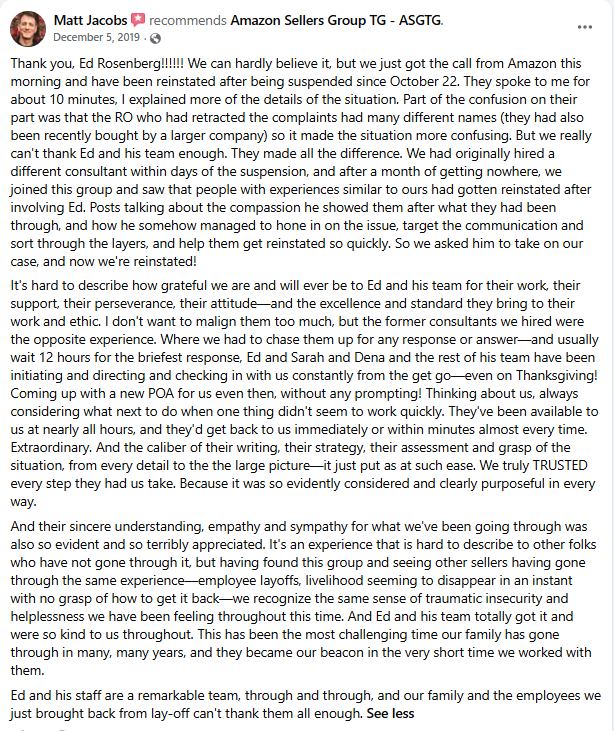
5 December 2019
A seller suspended since 22 October, reinstated six weeks later. The cause was a rights owner that had withdrawn its complaint but operated under several names after being acquired, so the withdrawal never matched the account. Employees had been laid off. They were brought back.
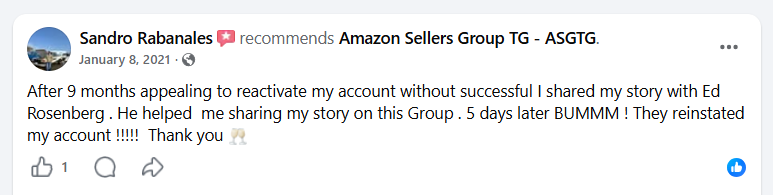
8 January 2021
The first seller recommendation posted after the indictment — after four months and three weeks of silence.
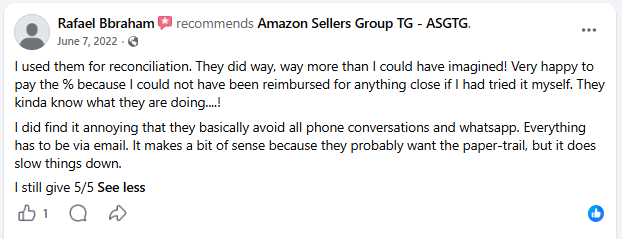
7 June 2022
Posted while the case was still pending. The seller paid, was satisfied — and complained that everything had to go through email rather than phone, guessing the reason was that they wanted a paper trail.
20 November 2024
Nineteen months after the guilty plea. Two months of failed appeals before ASGTG, then reinstatement.
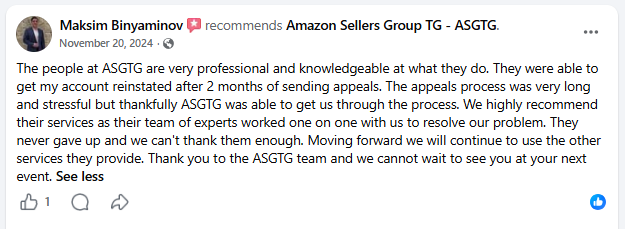
19 November 2025
The most recent. Two years and eight months after he pleaded guilty to bribing Amazon employees, sellers were still putting their names on public recommendations of his work.
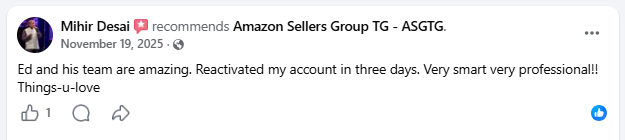
Verify for yourself
Amazon's own people, in writing

Amazon staff at an ASGTG seller event, 2019.
While the government says Ed Rosenberg was running a conspiracy against Amazon, Amazon's own employees were writing to him. These messages are dated inside the period the indictment covers.
In January 2018, an Amazon employee wrote to thank him for advocating for sellers and acknowledged he assists sellers with account concerns.
In October 2018, another wrote that he was one of the few seller group managers who really understood the approach to selling on Amazon, and committed to doing everything in their power to support a seller's reinstatement.
In January 2019, an Amazon representative relayed a message from the account-health team: they think well of your work, and asked me to send you a response.
Also in 2018, an Amazon Global Fulfillment Services manager wrote that they had heard great things about what he and his groups do for Amazon sellers, and asked for fifteen minutes of his time to understand what sellers needed.

Amazon Global Fulfillment Services — Seller Communities, 2018.
And an Amazon account health representative wrote that his work had generated quite the buzz, that they would love to support it in a more organized capacity the following year, and that they were advocating internally for exactly that.
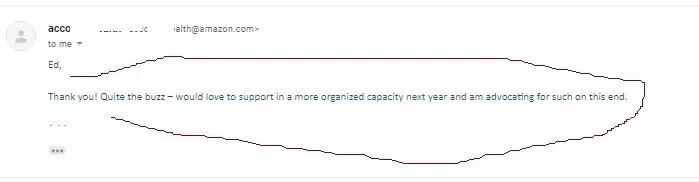
Amazon account health team.
Amazon's employees were asking to work with him. Amazon's lawyers asked a federal judge to put him in prison.
They also appeared in person. Amazon staff attended ASGTG events, and Rosenberg hosted a senior Amazon representative on stage:
What sellers said when the indictment came
The people who knew the industry read the charges and said so publicly, under their own names.
"I know Amazon and I know Ed. I believe his side of the story."
— Nate McCallister, e-commerce author and Amazon seller
"In a sensible world, Ed Rosenberg would have been awarded a gold medal by the DOJ for all of his efforts and the help he provided for the honest Amazon seller. It's a shame that he was prosecuted instead."
— Shimon Katz
More sellers, in their own words →
The charge of last resort
There is no federal law against commercial bribery. Paying someone at a private company to break their employer's rules is not a federal crime in the United States. Congress never made one.
So prosecutors borrow.
The Travel Act, passed in 1961 to chase mobsters across state lines, lets the federal government take a state offense and convert it into a federal felony — as long as the defendant used a "facility of interstate commerce." In 1961 that meant crossing a state line. Today it means sending an email.
A predicate is the underlying state crime that a federal charge is built on top of. Here the predicate was commercial bribery under New York and California law. Neither state charged him. The federal government used their laws anyway.Legal commentators describe this plainly: it is, in one law firm's words, a federalization of state law. The jury sits in a federal courthouse and is instructed on the elements of a state crime. When the Supreme Court narrowed the honest-services fraud statute that prosecutors had previously used to fill this gap, the Travel Act became the replacement — the fallback when the statute actually designed for the conduct doesn't fit.
Scholars warned about this before it became routine, cautioning that a broad reading would turn state misdemeanors into federal felonies and pull federal police power into matters Congress never assigned it. The Supreme Court approved the broad reading in 1979, over the argument that Congress had meant something narrower.
That is the law under which Ed Rosenberg was convicted. Not a federal crime. A state offense, federalized by an email.
Strip it down and the case looks like this: a private company's internal employment rules, converted into a state offense, converted into a federal felony because a message traveled over a wire. No federal program was defrauded. No public money was taken. No government agency was deceived. No federal victim existed at all — which is precisely why no restitution was ordered.
Amazon could have sued. Amazon could have closed accounts, which it does routinely and without explanation. Amazon could have fired the employees, which it did.
Instead it went to the Department of Justice. And the Department of Justice went to Ed Rosenberg's house at dawn — before anyone had ever asked him a question.
Amazon played every role
Amazon wrote the rules. Amazon decided they had been broken. Amazon investigated. Amazon referred the matter to the FBI and, in its own words, actively supported the investigation. Amazon supplied the evidence.
And at sentencing, Amazon came back one more time — as the victim, filing a statement that urged the court to reject the government's own recommendation and put Ed Rosenberg in prison.
Detector. Investigator. Referrer. Witness. Victim.
Five roles, one company, and not once did it have to defend its version of events under oath or face a single question on cross-examination. That burden fell entirely on the man it accused.
Ten employees. One charged. Nobody else, ever.
The indictment alleges bribes were paid to at least ten Amazon employees and contractors.
One was charged: Nishad Kunju, who was in Hyderabad, India. He was never arraigned. He remains a fugitive.
The other nine have never been publicly charged with anything.
This matters more than it may appear. Under the Travel Act, commercial bribery turns on a breach of the duty an employee owes an employer. Ed Rosenberg owed Amazon no such duty. He was not an Amazon employee. He had signed nothing promising Amazon his loyalty.
The people who did owe that duty — and who the indictment says broke it — were not prosecuted. The man who owed Amazon nothing was.
Nor did it stop. In August 2023 — one month after Rosenberg was sentenced — CNBC reported on a Telegram channel called "Amazon Magic," operating openly with more than 13,000 members, charging sellers $200 to $400 to remove negative reviews, recover suspended accounts, and leak competitor data by paying Amazon employees.
No one has been charged.
Read the reporting
What he actually paid for
The annotations were not secrets. They were sold openly — on Reddit, in Facebook groups, on public seller forums — commonly for around $50. Sellers used them. Consultants used them. Attorneys used them. Amazon suspended no one for using them, and today Amazon shows sellers the same information itself.
Most of the annotations attributed to Ed Rosenberg came to him from the sellers he was helping. They had already obtained them. They handed them over as part of their own case files, the way a client hands a lawyer their paperwork.
And there was a reason he needed them. By his own estimate, roughly half the sellers who came to him claiming innocence were not telling the truth — operating duplicate storefronts, hiding prior enforcement, running the schemes they claimed they hadn't. He was asking senior Amazon executives to spend their time on cases he vouched for. The notes were how he told the honest sellers from the liars before he put his own credibility behind them.
In other words: the information the government charged him for obtaining was the information he used to keep fraudulent cases away from Amazon.
And this is the part that should stop anyone reading it: the standard applied to him would have implicated the entire industry.
If obtaining an annotation is a federal felony, then every seller who bought one is a felon. Every consultant who worked a suspension case is a felon. Every attorney who used one to draft an appeal is a felon. Thousands of people, over years, doing the ordinary work of getting wrongly closed businesses reopened.
None of them were charged. The sellers who obtained the notes were not charged. The websites selling them were not charged. Ed Rosenberg was.
A rule that would convict an entire community, enforced against exactly one man — the one who had organized that community and turned it into a public voice against the company that made the referral.
The court said no
Amazon asked for prison. It argued the joint recommendation of the government and the defense was too lenient. It told the court that a term of incarceration was fair, just, and equitable.
The Department of Justice — the party that had indicted him, that had spent years investigating him, that had every institutional reason to want a hard sentence for its lead defendant — recommended no prison. So did the Probation Office, which answers to no one but the court.
Judge Richard A. Jones imposed probation.
He imposed something else, too — nothing. Federal sentencing guidelines let a judge bar a defendant from the very occupation used to commit an offense. The tool was available and it fit: the government's theory was that Ed Rosenberg's consulting business was the vehicle for the crime. No such restriction was imposed. He left that courtroom free to keep advising Amazon sellers and free to keep running ASGTG, and that is exactly what he has done ever since.
Amazon lost that argument. It lost it to the prosecutors it had brought the case to.
When a company insists a man belongs behind bars and the government prosecuting him says otherwise, that tells you which account of the facts survived contact with the evidence.
The headline is permanent. The correction never came.
The Justice Department publishes when it charges. It does not publish when the case falls apart.
In September 2020 it announced a conspiracy worth more than $100 million, with Ed Rosenberg named first. In July 2023 it announced that he had purchased forged supplier documents.
Those two announcements are the first things anyone finds when they search his name. His children's classmates find them. Every bank, every insurer, every business contact finds them.
What followed appears in no press release anywhere:
Six of seven counts dismissed. One count of conviction. A guidelines bribe value between $95,000 and $150,000. No prison. No restitution. No identified victim. No occupational restriction. A prosecution filing describing his business as legitimate and the conduct as an aberration from it. And a forged-documents allegation that appears in neither his plea nor his apology, attributed by the Department itself to someone else.
The Department of Justice corrected none of it. It never does.
Ed Rosenberg completed his sentence in full — two years of probation, twelve months of home confinement, a $100,000 fine paid, no violations. During probation he had to ask a federal judge for permission to spend a single night away from home. He asked. He was granted it. He complied with everything.
What remains was imposed by no judge. His bank accounts were closed and he had to open new ones. An application for life insurance was denied. He is inadmissible to Canada — barred from entering — because of a foreign conviction.
These are called collateral consequences: the restrictions that attach automatically to a criminal record, outside any sentence a judge hands down. A federally funded national inventory has catalogued more than 44,000 of them.A presidential pardon removes them. Nothing else does.
What he did with it
Ed Rosenberg believes what happened to him was a serious injustice. He has never taken back his apology, and he does not take it back now. He admitted what he did. He served every day of what he was given.
But he could not accept that the gap between the headline and the record was simply the way things work.
So he went looking for other people it had happened to. He found them, and he started writing their cases down — the documents, the dockets, the numbers, the same way he had once worked a suspended seller's file. That work became 43 Americans, and it became this website.
Ed Rosenberg is Case No. 1 of the 43 Americans. He documented the other forty-two.
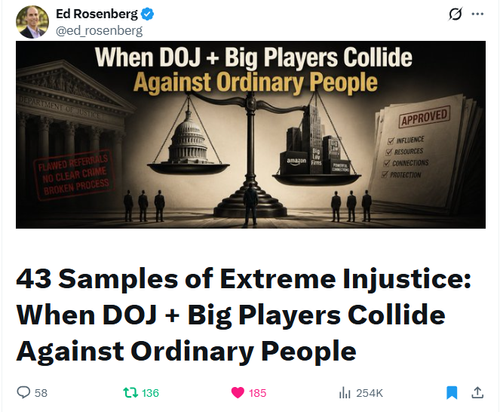
"43 Samples of Extreme Injustice: When DOJ + Big Players Collide Against Ordinary People." Read the article — over 250,000 views as of 16 August 2026.
The man the Justice Department announced as the centerpiece of a $100 million conspiracy spent the years after his conviction building a public record of other people's cases.
What's left
No seller has come forward saying Ed Rosenberg victimized them.
No account he escalated was suspended because of anything he did.
No victim was ever identified. No restitution was ever ordered. No cooperation was ever given.
The conspiracy became annotations. The prison sentence became probation, recommended by the prosecutors themselves. The $100 million became a $100,000 fine paid to the Treasury, because there was nobody to repay.
What remains is a man whose name was destroyed worldwide, who was debanked, whose wife and children watched federal agents carry the family's computers out of their home, and who spent more than two million dollars defending himself against a case the government itself described as an aberration from an otherwise legitimate business.
He still runs ASGTG. It has grown since the indictment. The sellers who know this industry read the charges and did not recognize the man in them — and they are still saying so, publicly, by name, five years later.
Our position, stated plainly
Everything above this box is sourced to a document, and the government's account is printed on this page beside ours, including the facts that cut against Ed Rosenberg. What follows is not a fact. It is our judgment, formed after reading the case file and the docket, and we put our name to it.
He paid for information he should not have paid for. He said so publicly before he was sentenced, and he pleaded guilty. Nothing here retreats from that, and nothing here calls the prosecution corrupt or dishonest — he agreed in his plea that it was not brought in bad faith, and we are not going behind that. Bad faith is a state of mind. Purpose is different. Purpose is what a prosecution actually did, and what it produced.
This was a private business dispute, and it was resolved with public force.
Amazon had every private remedy the law gives a company. It could have sued Ed Rosenberg. It could have closed his sellers' accounts, which it does routinely and without explanation. It could have fired the employees who took the payments — and it did fire them. Every one of those doors was open, and every one of them was Amazon's to pay for.
It went to the Department of Justice instead. And the Department took a private company's internal employment rules, ran them through a state offense neither state chose to charge, converted them into a federal felony because a message traveled over a wire, and sent armed agents to a family's home at six in the morning before anyone had ever asked the man a question.
No federal program was defrauded. No public money was taken. No government agency was deceived.
Then look at what five years of federal effort produced. No identified victim. No restitution. No prison — recommended by the prosecutors themselves. No occupational restriction. Six of seven counts dismissed. A prosecution filing describing the defendant's business as legitimate and the charged conduct as an aberration from it. Ten Amazon employees alleged to have taken payments, one charged, never arrested, and an identical market operating openly and uncharged today.
All of it was paid for by the public. A federal investigation, a five-year prosecution, the time of a United States Attorney's office and a federal court — funded by American taxpayers. The public's return on that expenditure was a $100,000 fine and two press releases that have never been corrected. The party that got something out of it was the corporation that made the referral, and it got a settled score it could not have obtained in a courtroom of its own, at no cost to itself and with no obligation to answer a single question under oath.
We do not find the Justice Department's actions in this case defensible, and we do not believe they served the interests of justice.
Not the decision to take a marketplace dispute and make it a federal case. Not the announcement of a $100 million figure the indictment itself defines as other people's sales revenue. Not the sentencing release attributing forged supplier documents to a man whose plea contains no such admission and whom the Department's own earlier announcement did not name for it. Not the choice to charge the one man who owed Amazon no duty at all while the employees who did owe one went uncharged. And not the decision to leave every word of it standing after the record went the other way.
Every federal prosecutor swears the same oath on the day they take the job: to support and defend the Constitution, and to faithfully discharge the duties of the office. That oath is not sworn to a case, to a conviction rate, or to any company's marketplace policies. It is sworn to Americans. The Supreme Court put the same duty in one sentence in 1935, and the Department still quotes it to itself: the government's interest in a criminal prosecution is not that it shall win a case, but that justice shall be done.
Measured against that standard, this prosecution served an interest. It was not the public's.
To say it once more so there is no mistaking it: this is our judgment about the conduct of an institution, not about the conduct of Ephraim Rosenberg, and not about the motive of any private party. It names no individual prosecutor, agent or judge, it asserts nothing about why Amazon made the referral it was entitled to make, and it accuses nobody of a crime. It rests on the documents linked on this page, which anyone can open and read. If the record shows we are wrong, tell us and we will say so here.
What this page does not claim
We do not claim he is innocent. He paid for information he should not have paid for, he said so publicly before he was sentenced, and he pleaded guilty. That stands.
We do not claim Amazon caused this prosecution. We claim what the record shows: Amazon detected the conduct, investigated it, referred it, supplied the evidence, appeared as the victim, asked for prison, and was never questioned under oath by anyone.
We do not claim the prosecution was brought in bad faith. He agreed in his plea that it was not, and we are not going behind that.
We do not claim the annotations were legal. They were not, and he has never said otherwise.
We claim one thing: what the Justice Department told the public is not what the Justice Department proved, the difference has never been corrected, and the conviction it sits on top of is still working on him today.
Weaponization analysis · 43 Americans · Case 1
How justice was weaponized in this case
This block is not part of Ed Rosenberg's story. It is our analysis of his record, written against the seven forms of weaponized justice documented elsewhere on this site. Weaponization here means one thing only, and the standard is the government's own: a prosecution is not an instrument for winning, but for seeing that justice is done — Berger v. United States, 295 U.S. 78, 88 (1935). Three of the seven forms are present in this case, and each rests on a dated filing, a government press release, or the Department's own sentencing submission rather than on an inference about anyone's state of mind. We do not assert what any individual intended, and we do not characterize the motive of any private party. We state what was done, and when. Four of the seven we considered and rejected, and we say so at the bottom.
Charges as bargaining instruments rather than descriptions of conduct
- 18 September 2020 — Seven counts, announced as a conspiracy worth more than $100 million. 30 March 2023 — six of the seven are dismissed and one remains: a Travel Act conspiracy built on a state commercial bribery statute neither New York nor California chose to charge. There is no federal commercial bribery statute at all.
- By sentencing, the government's own guidelines calculation valued the bribes at $95,000 to $150,000 — across six defendants, over three years. The exposure announced and the offense finally priced are not the same case.
- Acceptance of responsibility moved his offense level from 16 to 13 — the difference between a range that starts in prison and one that permits probation. The government decides whether contrition has been sufficient. Roughly 90% of federal cases end in a guilty plea; fewer than 3% reach a jury.
- The bargain contained the outcome before he signed it. He did not plead and then hope: the recommendation of no prison time was part of the agreement, jointly recommended in writing by the prosecutors who indicted him four months before sentencing.
- The motions deadline was extended four times and never used. On 27 March 2023 his lawyers asked for a fifth extension. Three days later he pleaded guilty and the request was withdrawn as moot. Not one substantive motion was ever filed — nothing challenging the dawn search of his home, nothing challenging the charges.
- He reports spending more than $2 million before a single motion was filed, and estimates that carrying the case through trial would have run into the tens of millions.
- The plea agreement he signed contains no cooperation provisions. No substantial-assistance motion was ever filed. He testified against nobody and named nobody, and received probation anyway.
The charge that carried the exposure was never tested, because testing it cost more than the sentence did.
The cost arrives before any verdict, and no outcome returns it
- September 2020 — Federal agents arrive at the family's Brooklyn home at six in the morning carrying rifles. His wife and children are there; he is not. The agents leave with three storage devices, a desktop and three laptops. He had never been asked a question.
- The case ran two and a half years. Five stipulated continuances. Nearly everything in the file — account records, internal notes, employee emails — belonged to a company that was not a party and not on trial, so defense access ran through that company's lawyers, and only one side of that exchange was paying by the hour.
- $154,267.50 is documented here for four months and two of three firms. Nearly $42,000 in June 2023 went to drafting a single document — the memorandum asking the judge not to impose prison. He paid it down in instalments of $1,500 and $3,000. A week before sentencing he still owed one firm $62,632.50.
- The judgment produced no restitution, because no victim was ever identified, and a $100,000 fine to the United States Treasury, which is where fines go when there is nobody to repay.
- What the sentence did not impose, the record did. His bank accounts were closed. A life insurance application was denied. He is inadmissible to Canada. A federally funded national inventory catalogues more than 44,000 such collateral consequences.
- The Department's own Justice Manual requires a pre-conviction press release to note the presumption of innocence. It contains no provision at all for correcting or removing a release once the record supersedes it. The 2020 announcement of a $100 million conspiracy, and the 2023 announcement that he purchased forged supplier documents, both still stand — and both are still the first things anyone finds when they search his name.
Rules going in. Nothing coming out.
A private party aims the state's power at a rival, and the state carries out the strike
- The rules broken were not written by a government. Commercial bribery is not a federal offense. What was federalized here was a private company's internal employment policy, converted through a state statute and an email into a federal felony.
- Amazon wrote the rules, decided they had been broken, investigated, referred the matter to the FBI and, in its own words, actively supported the investigation. Amazon supplied the evidence.
- Amazon owned the file. It was not a defendant and had no obligation to produce anything on the defense's schedule. Every hour of asking was billed to the man it had reported.
- At sentencing, Amazon returned as the victim, filing a statement urging the court to reject the government's own recommendation and impose a term of incarceration. It lost that argument to the prosecutors it had brought the case to, and it was awarded no restitution.
- Detector, investigator, referrer, witness, victim. Five roles, one company, and not once did it have to defend its version of events under oath or answer a question on cross-examination.
- The man charged first was the organizer of the largest independent Amazon seller community in the world, whose #WorkWithUsAmazon petition drew more than 12,500 signatures and forced direct engagement with Amazon's leadership on its suspension practices.
- The indictment alleged bribes to at least ten Amazon employees and contractors. One was charged, in India, and never arraigned. Under the Travel Act, commercial bribery turns on a breach of the duty an employee owes an employer. Ed Rosenberg owed Amazon no such duty. The people who did were not prosecuted.
- 2023 — Three years after the indictment, the Federal Trade Commission and a coalition of state attorneys general allege in FTC v. Amazon.com that Amazon's own internal study found its sellers live in constant fear of arbitrary suspension. Amazon denies the allegations and nothing has been proven; the court declined to dismiss the federal claims in September 2024.
A referral is a lawful thing to make, and making one is protected. What follows it is the government's choice, and the government made every one of them.
What this analysis does not claim, and why the list stops at three. It does not claim that any individual acted corruptly, and it accuses no prosecutor, agent, judge or company employee of a crime. It does not characterize why Amazon made the referral it was lawfully entitled to make; we publish the documented sequence and stop there. Every item above is a dated act, a filing, or the Department's own words, taken from the public record. We considered and rejected four of the seven forms. There is no political weaponization here — nothing connects this prosecution to any affiliation or public office, and we will not manufacture one. There is no regulatory weaponization: no licensing board or government regulator handled this first, and a private marketplace is not a regulator, whatever it does in practice. We make no career claim, because we cannot document one. And we specifically considered cognitive weaponization and decided against it — this case never reached a trial, so there is no testimony from the agents who built it, and we will not infer how an investigation reasoned from a press release alone. Three documented forms are worth more than seven asserted ones.
Nothing that happened here required an Amazon account
Take Amazon out of it. What is left is machinery — and every part of it is sitting in every federal district in the country.
Read it and ask which parts could not reach you.
- A private company's rules can become a federal felony. There is no federal law against commercial bribery. The Travel Act borrows a state offense, and an email supplies the federal hook. The rules you are prosecuted for breaking do not have to be written by a government.
- The number in the announcement is not the number in the case. A press release said $100 million. The guidelines put the bribes between $95,000 and $150,000, across six people, over three years. The announcement is written before anything is tested. Nobody publishes the revision.
- The company that reported you owns the evidence. It is not a party. It is not on trial. It has no obligation to hand anything over on your schedule. Your lawyers bill for every hour of asking, and the company's lawyers do not.
- The people who owed a duty may not be the people charged. Commercial bribery is a breach of an employee's duty to an employer. Ten employees were alleged to have taken payments. One was charged, and never arrested. The man who owed Amazon nothing was prosecuted.
- Contrition has a price, and the government sets it. Admitting the offense takes three levels off the sentencing formula. That is often the difference between prison and probation. Whether you have shown enough of it is not your call.
- The deadline to fight expires because you cannot afford to meet it. The motions deadline in this case was extended four times and never used. Three days after the last request for more time, the case ended in a plea. Not one challenge to the search or the charges was ever filed.
- The record can clear you and the headline stays. No prison. No restitution. No identified victim. No occupational restriction. A prosecution filing calling the business legitimate. None of it was ever announced, and the original announcement is still the first thing anyone finds.
None of that is specific to selling on Amazon. It is specific to being charged.
A contractor who paid a supplier's employee for a price list. A recruiter who bought a competitor's org chart. A freight broker who paid for routing data. A consultant in any industry who bought information that turned out to be internal, in a market where everyone was buying it. Anyone whose business depends on a single platform that can close their account without explanation, and who pays someone to find out why.
This page is not claiming an innocent man was picked at random. Ephraim Rosenberg paid for information he should not have paid for. He said so publicly before he was sentenced, and he pleaded guilty. The claim is narrower and harder: not one item on that list turns on how serious the conduct was, or on whether it was ever proven. Every one of them attaches the moment the government decides to charge you, and they keep working whether the case is strong, weak, or never tested at all.
He is one man in Brooklyn. The machinery that produced this is federal, and it is everywhere. That is why there are forty-three of these pages and not one.
The askNot mercy. Correction.
He is not asking to be let out of anything. There is nothing left to be let out of.
Two years of probation, served. Twelve months of home confinement, served. A $100,000 fine, paid. No violations. During probation he asked a federal judge for permission to spend one night away from home, and waited for the order.
He is not asking a court to undo the conviction either. He gave up the right to appeal as part of the bargain, and he has never taken back what he admitted.
What is wrong here was never in a court's judgment. It was in a press release.
A $100 million conspiracy. Forged supplier documents. Neither appears in the count he pleaded to. Neither appears in the apology he published. One of them the indictment defines as other people's sales revenue; the other the Justice Department attributed to a different defendant by name.
No court can fix that, because no court ever said it. The Department that said it does not issue corrections. And the conviction it sits on top of keeps working — on his bank accounts, on his insurance applications, on his ability to cross a border, on what his children find when they search their own last name.
One office in the country can answer a permanent government statement with a stronger one.
Six of seven counts dismissed. Ten Amazon employees alleged to have taken payments; one charged, never arrested. An identical market operating openly today, uncharged. No victim in six years. Not one dollar of restitution. No cooperation, and no one informed on. Two million dollars spent, and not a single motion filed.
Ephraim "Ed" Rosenberg is asking for a presidential pardon.
Read the record yourself
- The indictment, September 2020 — published by the Justice Department. Paragraph 26(t) defines what the $100 million figure actually consists of.
- The sentencing announcement, July 14, 2023 — the forged-documents claim, in the Department's own words.
- FTC v. Amazon.com, Second Amended Complaint — paragraph 258, at page 82, on what Amazon's own study says about its sellers.
- All 124 seller recommendations — every one attached to a named profile, spanning 2017 to 2025.
Three documents quoted above are not published here. The plea agreement, the government's sentencing submission and the defense sentencing memorandum are on the public docket in United States v. Rosenberg, No. 2:20-cr-00151 (W.D. Wash.), and can be retrieved through PACER or CourtListener. Attorney invoices quoted for fee figures are not published, because they contain privileged material.
What you can do
This page exists because almost nobody hears about cases like this one. The announcement travels. The record does not. That is true of all forty-three cases in this record, and this is the first of them.
- Read it and pass it on. Send it to one person who would find it hard to believe.
- Bring it up at dinner. Not as a cause. Just as something you read and could not get out of your head.
- If you sell on Amazon, or used to — we want to hear what a suspension actually did to your business, and what the appeals process was like. Whether or not you ever dealt with ASGTG.
- If you worked at Amazon in seller performance, account health, or seller support — in any year — we want to hear from you, and we will not publish your name.
- If you are a consultant or an attorney who worked suspension cases between 2016 and 2020, tell us what the annotation market looked like from where you stood. That is the single most important thing anyone reading this page could add to it.
- If you are a lawyer of any kind, we want to hear from you — including, and especially, if you think we have something wrong. Corrections make this stronger, and this page will publish them.
- If you know a reporter, tell them. Every document here is public, linked, and checkable. This story can be verified in an afternoon.
- Sign the petition. It takes a minute.
Ephraim Rosenberg has completed every day of his sentence. He is asking the President for a pardon.
Share this page
Reporters, lawyers, and anyone with information
Follow 43 Americans on Facebook for the other forty-two cases.
The full story, in his own words
Who wrote this, and who did not
This page was written and published by 250pardons.com as Case 1 of the 43 Americans. Ephraim Rosenberg provided documents, answered questions, and asked for specific corrections, and where he is quoted the words are his. He is not the author of this page, and the arguments and conclusions in it are ours.
No lawyer wrote this page, reviewed it, or endorsed it. Nothing here should be attributed to Jacob Laufer, Peter Offenbecher, or any attorney who has represented him at any stage.
This page is not his pardon petition and does not state his legal position. His petition is his own document, filed in his own words. Where anything here differs from what he has filed, his filing governs and this page does not.
He has not disavowed his guilty plea or his public apology, and nothing on this page should be read as doing so on his behalf. He admitted the conduct described in his apology. He pleaded guilty. He served his sentence in full. This page argues that the punishment and the public characterization went past the conduct — not that the conduct did not happen.
On the sections headed "Our position" and "Weaponization analysis." Both are clearly marked as our judgment about an institution, formed after reading the record published on this page. Neither names an individual prosecutor, agent or judge as having acted corruptly or unlawfully, neither accuses anyone of a crime, and neither characterizes the motive of any private party. Where a person or company is named anywhere on this page, the name appears because it appears in a public court document or a government press release linked here. Any person or company named here may write to us and we will publish their response alongside.
Ephraim Rosenberg has also written extensively about this case on his own accounts and blogs. Those are his arguments, published under his own name. This page does not adopt them, and several claims made there do not appear here.
Nothing here is legal advice, and nothing here is a prediction of any outcome.
A note on quotation and proof. Passages presented as quotations are exact text from a named filing, press release, court order or published statement, with the source identified. Figures from Justice Department press releases are allegations, not findings. There was no trial in this case, so no jury has found any fact in it. Allegations in the indictment were never proven; six of seven counts were dismissed. Statements introduced with he says are his own account and have not been tested by cross-examination — this includes the total legal fees, the estimated cost of a full trial, the circumstances of the raid, the number of escalations, the growth of the ASGTG community since 2020, and the account of who the annotations came from. Fee figures for four months of 2023 come from attorney invoices held by this site and not published. Document numbers refer to the docket in United States v. Rosenberg, No. 2:20-cr-00151 (W.D. Wash.), unless another case is named. FTC v. Amazon.com is a pending civil case in which nothing has been proven and Amazon denies the allegations.
If any passage on this page does not match the record, tell us and we will correct it. That promise is the only thing that makes the rest of it worth reading.
Sources: United States v. Rosenberg, No. 2:20-cr-00151 (W.D. Wash.), Hon. Richard A. Jones — indictment (Dkt. 1), plea agreement (Dkt. 182), government sentencing submission (Dkt. 195), defense sentencing memorandum (Dkt. 196), victim impact statement, judgment (Dkt. 199), and docket. U.S. Department of Justice, U.S. Attorney's Office, W.D. Wash., press releases of 18 September 2020 and 14 July 2023. FTC v. Amazon.com, Inc., No. 2:23-cv-01495-JHC (W.D. Wash.), Second Amended Complaint (Dkt. 327, 31 October 2024) and Order on Motion to Dismiss (Dkt. 289, 30 September 2024). Amazon Services Business Solutions Agreement, Internet Archive captures of 13 March 2019 (web/20190313040141) and 1 December 2020 (web/20201201211127), reproduced on this page as screenshots of those captures. ASGTG Facebook page, seller recommendations, captured 2026. Attorney invoices, Skellenger Bender and Jacob Laufer, P.C. Annie Palmer, CNBC, 18 September 2020 and 1 August 2023. Ina Steiner, "Amazon Bribery Plea: One Count, Possibility of No Jail Time," EcommerceBytes, 30 March 2023. On the Travel Act: Perrin v. United States, 444 U.S. 37 (1979); Quarles & Brady, "The Travel Act in Federal Health Care Fraud Prosecutions"; NYU School of Law, Compliance and Enforcement, "Confronting Percoco and Full Play" (11 September 2024). On the standard applied in the weaponization analysis: Berger v. United States, 295 U.S. 78, 88 (1935); DOJ, Justice Manual 1-7.000. U.S. Sentencing Commission, annual sourcebook. National Inventory of Collateral Consequences of Conviction.